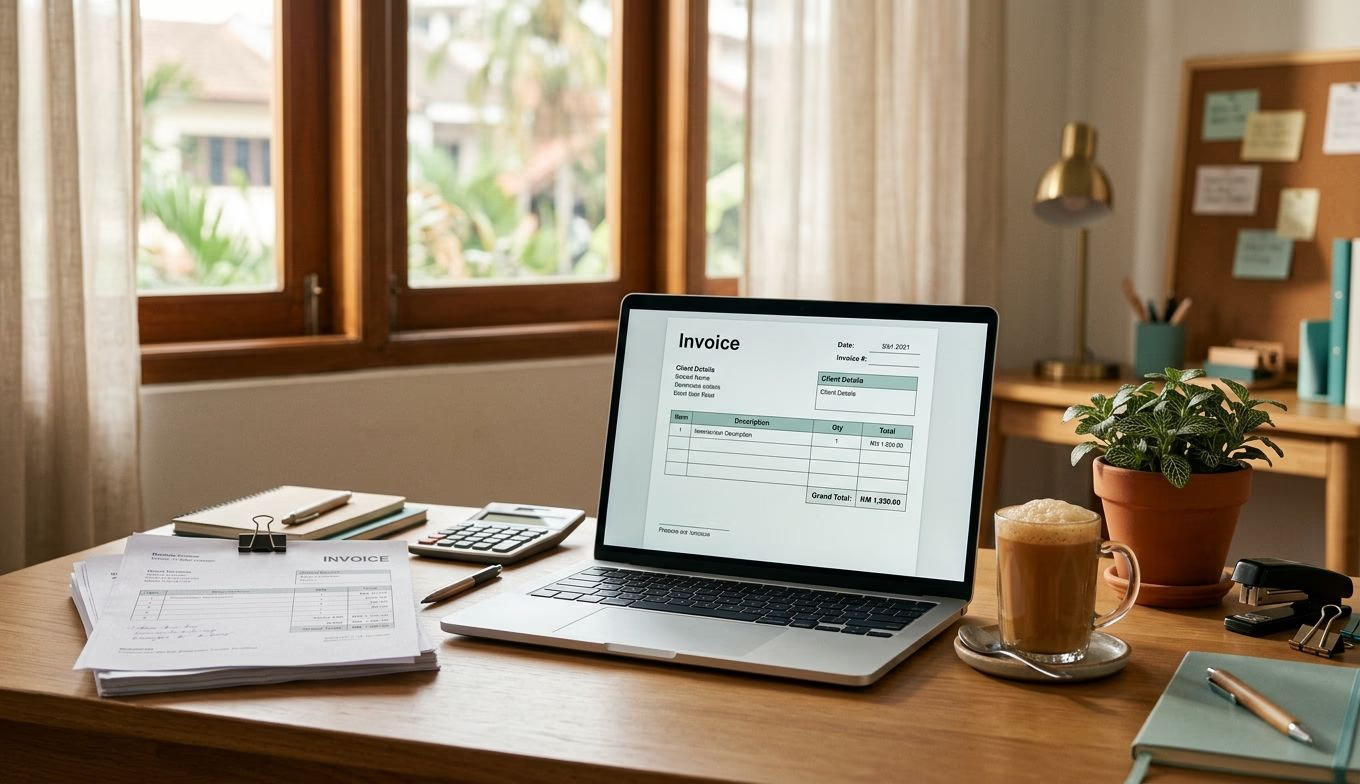

Short answer: yes, foreign SaaS like ChatGPT, Canva, and Notion are treated as royalty under Section 109 of the Income Tax Act 1967, so 10% withholding tax (WHT) technically applies when a Malaysian business pays a non-resident vendor. Where the WHT on a single transaction is RM500 or less (most consumer-tier SaaS), you can file half-yearly instead of monthly, but it is a deferment, not an exemption.
A Malaysian business owner posted this in early May 2026: his company spends about RM1,300 a month on ChatGPT, Canva, Notion, and similar subscriptions, and he does not claim them as a business expense. He pays from his own pocket because he believes claiming triggers WHT obligations he cannot meet. If you run a Malaysian business, you have probably had the same thought, or worse, you have been claiming these for years and never heard of WHT.
Heads-up. Published 9 May 2026. Malaysian tax rules, forms, and treaty positions change. Verify on hasil.gov.my or with a licensed tax agent before filing. General information, not tax advice.
What withholding tax actually is, in one paragraph
Think of it as a small tax Malaysia takes before your money leaves the country. When a Malaysian business pays a foreign company for software, services, or interest, the law says you have to hold back a slice for LHDN and send only the rest to the vendor. For a typical SME paying for foreign SaaS, the slice is 10% under the royalty rule.
The 8% you may have seen for Google and Facebook ads is the same rule, just trimmed by tax treaty (Singapore for Google, Ireland for Meta). Without treaty paperwork on file, the rate goes back to 10%.
Is a software licence really subject to withholding tax?
This is where most business owners trip up. A ChatGPT Plus subscription does not feel like a royalty. You are paying for cloud access, not licensing a movie.
LHDN sees it differently. The Income Tax Act defines "royalty" broadly: any payment for the right to use copyrights, software, patents, designs, and similar things. Cloud-delivered software falls inside that definition, so when you pay OpenAI USD20 a month, in LHDN's eyes you are paying a royalty to a foreign company.
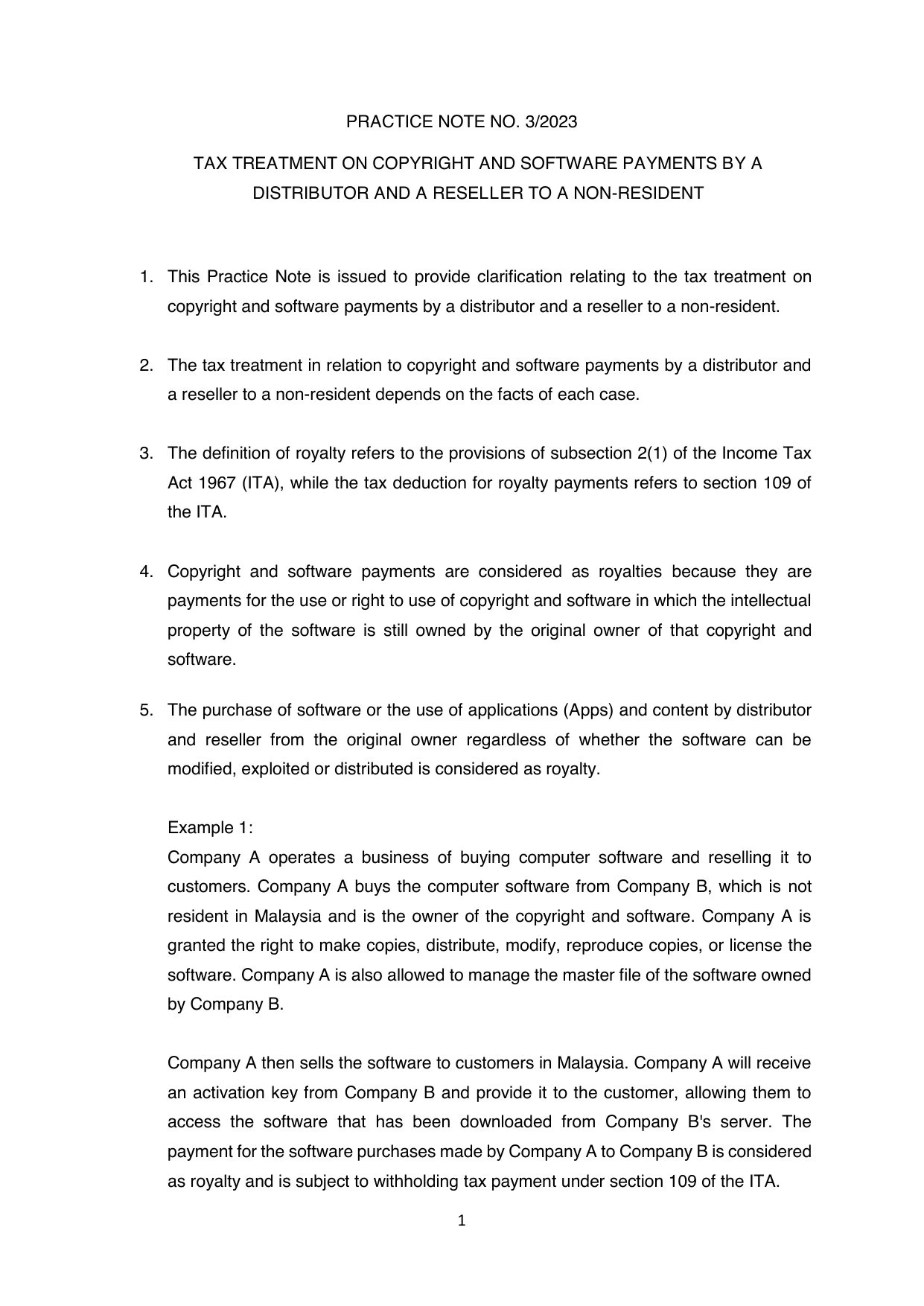 LHDN Practice Note 3/2023 spells out the rule for distributors and resellers. The same royalty logic extends to ordinary businesses through a separate draft public ruling. Source: MAICSA technical announcement.
This view is reinforced in Practice Note 3/2023 (for distributors and resellers) and a draft public ruling on royalties for software that extends the same logic to ordinary businesses. The only carve-out is for individuals using software for personal reasons. Businesses get none.
LHDN draws a small distinction in the paperwork:
- Buying access to an application (most SaaS) is royalty. File Form CP37.
- Buying a custom service (foreign consultant, bespoke developer) is a Section 109B service fee. File Form CP37A.
Both are taxed at 10%. So when you pay USD20 a month for ChatGPT Plus, the 10% rule applies and CP37 is the right form.
Two things called "8%", don't mix them up
This trips up almost every business owner.
8% withholding tax on Google and Facebook ads is the royalty rule above, reduced by tax treaty. You file it with LHDN.
8% Service Tax (SST) on imported digital services is a different tax. You pay it to RMCD (Customs), under a different law. It appears as a line item on your ChatGPT or Canva invoice. The rate went from 6% to 8% in March 2024.
Same number, two different taxes, two different agencies. The SST on your ChatGPT invoice does not count toward your WHT.
What LHDN actually audits
The law is one thing. Enforcement is another. LHDN does not publish enforcement statistics by transaction size, so what follows is practitioner consensus. Audit attention concentrates on big-ticket foreign payments:
| Payment type | Why LHDN cares |
|---|---|
| Foreign consultants and advisors | High value per invoice, easy to spot |
| Enterprise software licences (Oracle, SAP, Microsoft) | Large lump sums, clearly royalty |
| Cloud hosting on enterprise tiers (AWS, Azure, GCP) | Material business expenses, often six figures |
| Foreign film and post-production work | Industry-specific audits |
| Loans and interest paid offshore | Interest WHT and transfer-pricing flag |
What LHDN does not typically chase invoice-by-invoice is USD20-a-month consumer SaaS on a company credit card. The audit cost-to-yield is poor, and the small-value rule (next section) legitimately moves those to half-yearly filings.
The small-value rule (which is a deferment, not an exemption)
This is the rule most online guides get wrong, and the one that matters most for day-to-day SaaS spending.
Simple version: if the WHT on a single payment is RM500 or less, you can file half-yearly instead of monthly.
The mechanics:
- LHDN announced this in a media release dated 27 September 2022, applied back to 1 August 2022.
- Monthly cadence (default): deduct, remit within one month, file Form CP37 (royalty) or CP37A (service fees).
- Half-yearly cadence (small-value): batch and file Form CP37S or CP37DS twice a year. Payments between 1 December and 31 May are due 30 June; payments between 1 June and 30 November are due 31 December.
- Intended for recurring small payments to the same vendor. A truly one-off small payment is safer to handle monthly.
This is a deferment, not an exemption. You still calculate and remit the WHT, just on a less frequent schedule. Anyone telling you small-value SaaS is "exempt" is wrong.
Plain math: a USD20 ChatGPT subscription is roughly RM95. The 10% WHT is about RM9.50, well under RM500, so it qualifies. Same for Canva Pro, Notion, Grammarly Premium, and most consumer-tier SaaS.
Sharp edge: the RM500 cap is per transaction, not per vendor. A RM60,000 annual SaaS invoice triggers RM6,000 of WHT in one go, way over the cap, so monthly cadence applies. Paying yearly to get a discount can flip you out of the half-yearly cadence. Worth doing the math before you click Annual.
What happens if you don't pay withholding tax
This is the actual trap, and it is bigger than the tax itself. If you don't withhold and remit when you were supposed to:
- The whole payment becomes non-deductible under Section 39(1)(j) of the Income Tax Act. That RM1,300 a month of SaaS spend stops counting as a business expense.
- You owe the unpaid WHT plus a 10% penalty.
- You can pay late (with the penalty) and restore the deduction. The penalty itself stays non-deductible.
On RM15,600 a year of SaaS, the lost shield is about RM3,744 at the 24% bracket (non-SMEs and SMEs above RM600k chargeable income) or RM2,340 to RM2,652 for SMEs in the 15 to 17% brackets. Either way, the asymmetry is the point: skipping a 10% WHT can cost a multiple of that in lost deduction.
The good news: if each invoice generates WHT under RM500 and you file half-yearly on Form CP37S or CP37DS, you stay compliant and the deduction is preserved.
What most SMEs actually do
Walk into ten Klang Valley SME accounts departments and you will see the same pattern: small foreign SaaS gets booked as a software expense with no WHT entry. Two things drive this.
The gross-up problem. Stripe charges the full USD20 for ChatGPT Plus. There is no tickbox to withhold 10%, so compliance means paying about RM10 of WHT to LHDN out of your own pocket on top of what the vendor charged. That stings.
The half-yearly cadence is doable. A properly run finance function tracks foreign SaaS spend and batch-files Form CP37S or CP37DS twice a year. The risky third path, ignoring WHT entirely, is common but exposed in a broader audit.
How to file withholding tax in Malaysia, step by step
For most SMEs paying foreign SaaS, this is the practical sequence.
Step 1: Get your tax setup in order. You need a company Tax Identification Number (TIN) and a MyTax account at mytax.hasil.gov.my. If your accounting firm or company secretary set up the company, they have the login.
Step 2: List foreign SaaS and consultants in your books. Pull every payment to a non-resident vendor each month, with country, MYR amount, and recurring or one-off flag.
Step 3: Compute the WHT. Default 10% of the gross. Lower if a tax treaty applies and you have a valid Certificate of Residence from the vendor. For consumer SaaS without that paperwork, assume 10%.
Step 4: Decide cadence per invoice. WHT of RM500 or less per single transaction goes into the half-yearly batch. Above RM500 goes onto the monthly cadence (one-month deadline).
Step 5a: Monthly cadence (Form CP37 or CP37A). Within one month of payment, file via the e-WHT system on MyTax (mandatory since 1 September 2023), then pay LHDN via FPX, online banking, or an approved bank counter.
Step 5b: Half-yearly cadence (Form CP37S or CP37DS). Batch qualifying small-value payments. Window 1 Dec to 31 May filed by 30 June; window 1 Jun to 30 Nov filed by 31 December. Submit through MyTax and remit the batch total.
Step 6: Keep the paperwork. Submitted form, LHDN remittance receipt, vendor invoice. Section 82A of the Income Tax Act 1967 requires at least 7 years of records.
Step 7: When in doubt, ask a tax agent. Treaty-rate claims, Labuan-routed payments, lump-sum enterprise licences, and mid-year billing-country changes are all worth a tax agent's eyes.
Our take, after working with Malaysian SMEs on AI tools
We help Malaysian businesses build software, including AI-powered systems and custom AI solutions, and the WHT question comes up almost every project that touches a foreign API. Most founders are over-cautious in the wrong direction: they either ignore WHT entirely or panic and stop claiming legitimate expenses.
The middle path is simple. Track foreign SaaS spend, use the half-yearly cadence on the small invoices that qualify, withhold properly on the few large ones that don't, and talk to a tax agent once a year. If your foreign SaaS bill is climbing past RM5,000 a month, that is the moment to bring one in. One hour of advice costs less than one month of disallowed deduction.
For broader strategy decisions, see our build vs buy software guide for Malaysian businesses.
Practical SME playbook
Half-yearly filing is enough (Form CP37S or CP37DS):
- ChatGPT Plus, Claude Pro, Perplexity Pro at USD20 to 30 per month
- Canva Pro, Notion individual, Figma starter, Grammarly Premium, Loom, Zapier starter
- Vercel, Netlify, Cloudflare on consumer pricing
- Most monthly developer tools under RM200 each (per-invoice WHT under RM500)
Monthly filing is required (Form CP37 or CP37A):
- Annual SaaS deals where a single invoice triggers more than RM500 of WHT (a RM5,001 contract triggers RM500.10, just over the cap)
- Enterprise tiers from foreign vendors with no Malaysian presence
- Custom service work from a named foreign consultant or developer
- Foreign agency retainers above the RM500-per-invoice line
- Enterprise cloud contracts
Always talk to a tax agent first:
- Lump-sum software licence purchases (Oracle, SAP, custom enterprise software)
- Cross-border consulting engagements above RM50,000
- Anywhere a tax treaty might reduce the 10% rate (US, UK, Singapore, Australia commonly)
- Payments routed through Labuan entities
Keep these documents either way:
- Vendor invoices showing country of incorporation
- A short note on each foreign payment: why WHT applies and which cadence
- For payments where you withheld: copies of the form filed and the LHDN remittance receipt
Want a free estimate for your project?
Thinking about replacing a stack of foreign SaaS with custom software, or want to build AI tools that you own outright? WhatsApp us and tell us what you are using today, or send us a message if WhatsApp is not your thing. We will give you an honest take on whether building beats buying for your situation.
Disclaimer
General information, published 9 May 2026. Not legal, tax, or accounting advice and not a substitute for a licensed Malaysian tax agent. Rates, forms, Practice Notes, and treaty positions can change; individual circumstances vary. Verify on hasil.gov.my or with a tax professional before you act. Gotchaa Lab disclaims liability for any reliance on this article.
References
- Withholding Tax (LHDN official page)
- Practice Note No. 3/2023: Tax Treatment on Copyright and Software Payments (MAICSA technical announcement)
- Draft Public Ruling for public consultation: Tax Treatment on Royalties for Payment of Software to a Non-Resident (LHDN)
- Deferment of WHT payments for small-value WHT transactions (EY Malaysia tax alert)
- Tax Implications on Digital Services (Crowe Malaysia)
- Withholding Tax Rates under Double Taxation Agreements (LHDN)
- Government clarification: no specific ChatGPT subscription tax (The Star, 31 Oct 2024)
- Tax Treatment of Copyright and Software Payments (KTP & Company)
- Public Ruling 10/2019: Withholding Tax on Special Classes of Income (LHDN)