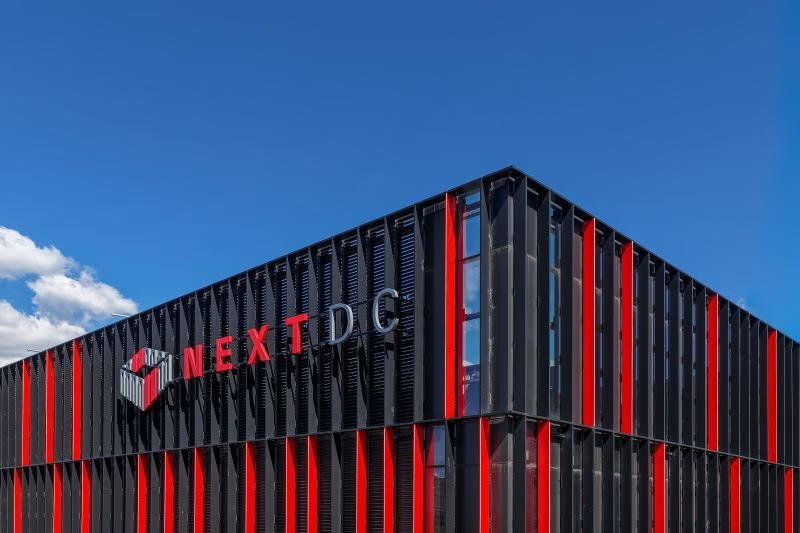
On 14 May 2026, NextDC switched on KL1, its first data centre outside Australia. It sits at 1 Jalan 51A/229, Seksyen 51A, Petaling Jaya, cost roughly RM2.8 billion (AUD$1 billion), and is built for 65MW of IT capacity across 18,250 square metres of technical space. It has since been certified by the Uptime Institute at Tier IV for both its design documents and the constructed facility, which makes it the first Tier IV facility in Peninsular Malaysia.
That last part is the headline most coverage ran with. AI-ready. Sovereign-grade. A milestone for AI Nation 2030.
All of it is true. Almost none of it matters to your business.
If you run a Malaysian SME, agency, SaaS startup or e-commerce shop, your hosting decision next month should not change because KL1 opened. The Tier 4 label is about to be marketed at you very hard, and a lot of Malaysian businesses are going to overpay for resilience they cannot use. Here's the honest read.
NextDC KL1 at a glance
| Operator | NEXTDC Limited (Australia), its first facility outside Australia |
| Address | 1 Jalan 51A/229, Seksyen 51A, Petaling Jaya, 46100 Selangor |
| Went live | 14 May 2026 |
| Investment | About RM2.8 billion (AUD$1 billion) |
| IT capacity | 65MW when fully built |
| Technical space | 18,250 square metres |
| Tier rating | Uptime Institute Tier IV, certified for design documents and for the constructed facility |
| What it sells | Enterprise colocation and cloud connectivity. Not virtual machines |
| Who buys it | Hyperscalers, telcos, banks and large enterprises with their own hardware |
Where is NextDC KL1?
In Petaling Jaya, Selangor, not in Kuala Lumpur proper, despite the "KL1" name and the "Kuala Lumpur" label NextDC uses in its marketing. The address is 1 Jalan 51A/229, Seksyen 51A, Petaling Jaya, 46100 Selangor. Plenty of people just call it NextDC PJ.
Can a small business rent space at NextDC KL1?
Probably not in the way you are picturing, though the entry point is lower than most people assume. NextDC's published smallest unit is a quarter rack, 10RU with up to 2kW, and it sells half and full racks above that. NextDC does not say which of those products are available at KL1, and it publishes no minimum contract term.
The real barrier is what colocation is. You buy, own and ship the servers; NextDC supplies the building, power, cooling and security. So this is only a product for a business that already runs its own hardware and wants it in a better building. If you were hoping to move a website onto it, that is not something KL1 sells at all.
A Tier 4 data centre in Malaysia is a facility designed and certified by the Uptime Institute for 99.995% uptime, roughly 26 minutes of downtime a year, with fully fault-tolerant power, cooling and network paths. NextDC's KL1 in Petaling Jaya is Peninsular Malaysia's first such facility. Sarawak's irix Kuching DC received Tier 4 certification in early 2025 for East Malaysia.
It is rarer than the marketing suggests. The Uptime Institute's Malaysia awards listing runs to 24 entries and only three of them are Tier IV. Only two hold the Tier IV Certification of Constructed Facility, which the Uptime Institute awards only after live system demonstrations on site, rather than for the drawings: KL1 and irix's Kuching 1 DC in Sarawak. A third, Exsim's EX1 in Kuala Lumpur, holds the Tier IV Certification of Design Documents only. So if a vendor tells you their Malaysian facility is Tier 4, ask which of the two certificates they hold. The design one is awarded on paperwork.
What is a Tier 4 data centre in Malaysia?
The Uptime Institute's tier system rates the physical infrastructure of a data centre, not the cloud service running on top of it. There are four levels.
| Tier | Uptime | Annual downtime | Redundancy | Typical user |
|---|---|---|---|---|
| Tier 1 | 99.671% | 28.8 hours | None (single path) | Small office server room |
| Tier 2 | 99.741% | 22 hours | Partial component redundancy | Small business primary site |
| Tier 3 | 99.982% | 1.6 hours | Concurrently maintainable (N+1) | Most enterprises and hyperscalers |
| Tier 4 | 99.995% | 26.3 minutes | Fault tolerant (2N or 2N+1) | Banks, exchanges, life-safety |
Tier 4 means every component is duplicated and the facility can lose any single system, including a power feed or cooling loop, without going down. It typically costs roughly 25% to 40% more to build per megawatt than Tier 3, and that premium rolls through to the colocation rates customers pay.
Two things are usually misunderstood. First, Tier 4 is a rating of the building. If the software you run on top of it crashes, the tier rating does not help you. Second, most major clouds (AWS, Azure, Google) do not publish per-facility Tier 4 certifications. Their resilience model is multi-zone redundancy, not single-building Tier 4. A region with three availability zones at Tier 3 is, in practice, more resilient than a single Tier 4 building.
Is AWS a Tier 4 data centre?
No, and that's a feature, not a bug. AWS does not pursue Uptime Institute tier certifications for its facilities. Its resilience model is built on multiple Availability Zones per region, each backed by one or more physically separate data centres. If one AZ goes down, your workload fails over to another. The same logic applies to Azure and Google Cloud. So when you compare "AWS Singapore region" to "a single Tier 4 building in Malaysia", the AWS region is, in most realistic failure scenarios, the more resilient option, despite no Tier 4 sticker on any individual building.
What KL1 actually is, and what it is not
KL1 is wholesale colocation. NextDC builds the building, runs the power, cooling and security, and sells rack space (or whole halls) to large customers, mostly hyperscalers, telcos, and enterprises that operate their own kit. NextDC is not a cloud provider in the AWS sense. You cannot sign up for a virtual machine on their website.
That means a 5-person Malaysian SaaS startup is not really a NextDC customer, even though NextDC's rack products start at a quarter rack. A facility sized at 65MW is built around cages and suites for customers drawing hundreds of kilowatts, and you still have to own the servers going into the rack. This is enterprise infrastructure buying, not Vercel pricing.
What KL1 changes is the upstream. If AWS, Azure, Google, Oracle or Alibaba lease capacity at KL1 (which is the whole point of the facility being there), Malaysian customers may eventually see a stronger Kuala Lumpur cloud region, with lower latency than Singapore and a cleaner PDPA story. That is a real and useful shift. It is also one you consume indirectly, through your existing cloud provider, not by signing a NextDC contract.
Who genuinely needs tier 4 in Malaysia
There are three buyer profiles where Tier 4 is the right answer.
Regulated financial institutions. Banks under Bank Negara's RMiT framework, stockbrokers, payment switches and Islamic finance operators that face hard uptime obligations. For these workloads, a 30-minute annual downtime budget is not a marketing line, it's a regulatory and reputational ceiling.
Latency-sensitive trading and exchange platforms. Bursa-adjacent infrastructure, FX engines, crypto exchanges with Malaysian licences, and any system where milliseconds translate to money. These shops already know they need Tier 4 colocation; they're not reading a blog to find out.
Large enterprises with hard data residency clauses. A handful of Malaysian government contracts, GLC vendor contracts and bank-tier procurement specs explicitly require in-country, fault-tolerant hosting. If your contract or your regulator forces residency plus a fault-tolerant rating, you go to a place like KL1.
Outside of these three, the Tier 4 premium is almost always wasted spend.
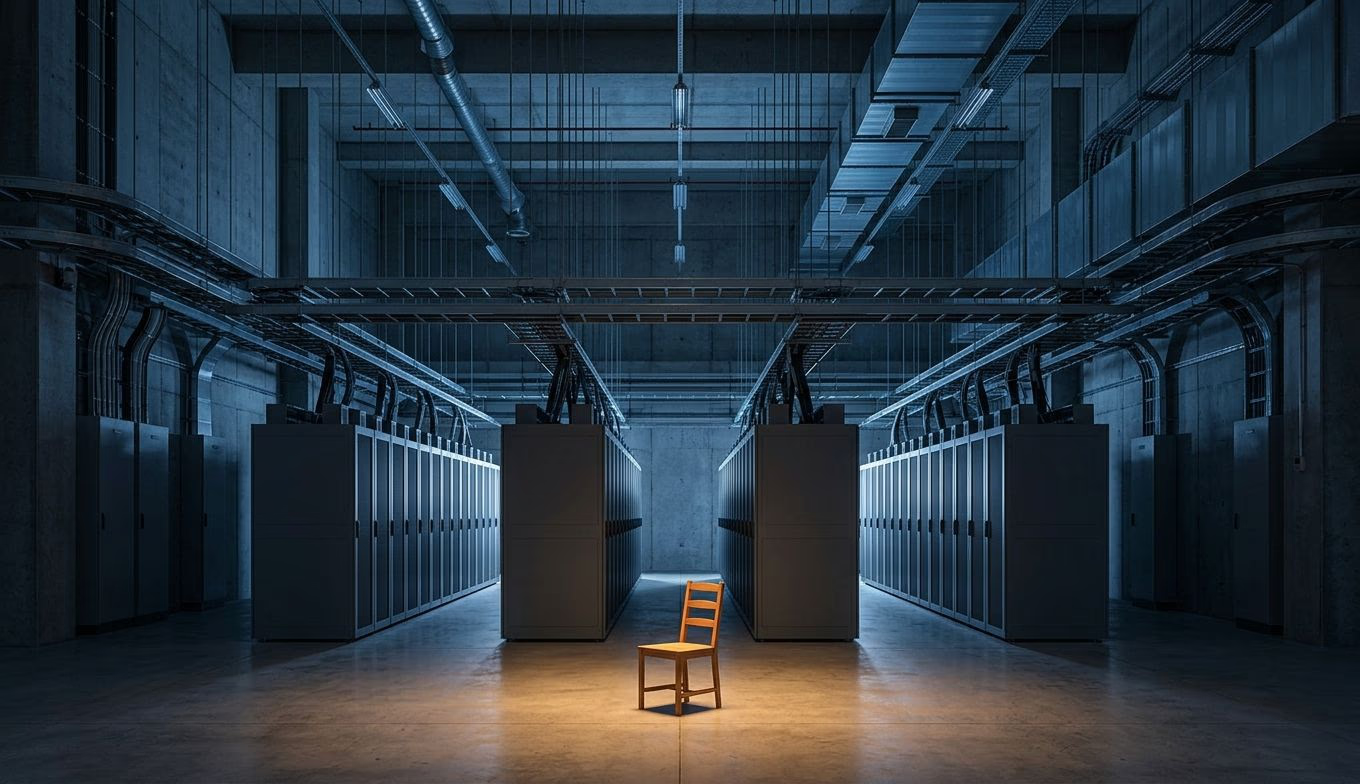 Tier 4 infrastructure is built for fortress-scale workloads. Most Malaysian businesses are the small chair, not the fortress.
Who doesn't need it (probably you)
If your business is any of the following, do not let a colocation salesperson talk you into a Tier 4 contract:
- A SaaS startup running on Vercel, Fly, Cloudflare, Supabase, Render or AWS Lambda. Your platform already abstracts the data centre away. Your uptime depends on your code and your provider's regional setup, not on the tier label of any single building.
- An agency or e-commerce shop on Shopify, BigCommerce, WordPress hosting or AWS Lightsail. Your hosting decision is about cost, support and ease of use, not Tier 4.
- A typical SME running internal apps on a hyperscaler region. AWS ap-southeast-5 (Malaysia, open since August 2024), ap-southeast-1 (Singapore) or ap-southeast-3 (Jakarta) give you three-AZ redundancy that meets or exceeds Tier 3 outcomes for a fraction of the price.
- An AI shop running local inference on your own GPU box. If you've already gone down the local AI route, your bottleneck is GPU economics, not Tier 4 power redundancy.
For these workloads, a Tier 3 colocation rack, a hyperscaler region, or a serverless platform is the right answer. Tier 4 buys you the difference between 1.6 hours and 26 minutes of annual downtime. For a normal SaaS business, that delta is worth maybe a few hundred ringgit a year in revenue protection. Tier 4 pricing will ask for tens to hundreds of thousands.
Our honest take
KL1 is genuinely good news for the country. More local capacity, a Tier 4 anchor tenant, real competition for Singapore in regional cloud and AI workloads, and one more concrete step toward the sovereign AI cloud narrative the government has been pushing.
It is not particularly good news for your AWS bill. The Tier 4 label is going to be repackaged by resellers, managed hosting providers and consultancies into "AI-ready Malaysian sovereign Tier 4 hosting" pitches over the next 12 months. Most of those pitches will be aimed at SMEs and startups who would be better served by a Tier 3 facility, a hyperscaler region, or just better software. We've watched this movie before with private cloud, with on-prem GPU clusters, and with the early MSC-era Cyberjaya pitch.
The honest read: KL1 raises the ceiling for what Malaysian-hosted infrastructure can do. It does not raise the floor for what your specific business needs. Those are different decisions.
Three questions to ask your cloud vendor this month
If a vendor (or your own team) brings up moving to KL1, or to any Tier 4-branded hosting, work through these before you sign anything.
- What does an hour of downtime actually cost us? If the answer is less than RM5,000 and you're already on a Tier 3 setup, the math for Tier 4 doesn't work. The premium will exceed the loss you're insuring against. For most Malaysian SMEs and startups, the honest cost-of-downtime answer is closer to RM500 per hour than RM50,000.
- Can our application even use the extra redundancy? Tier 4 fault tolerance is a property of the building. If your application runs on a single VM, with a single database, and a single deployment target, you get zero benefit from Tier 4 hardware. The bottleneck is your architecture, not the colocation tier.
- Is our residency requirement a legal one or a marketing one? PDPA does not, by itself, force in-country hosting for most categories of personal data, though it requires care with cross-border transfers. If your "we host in Malaysia" line is a marketing claim, a hyperscaler region or even Tier 3 Malaysian hosting will do. If it's a contractual or regulatory line (bank, government vendor, healthcare), then yes, KL1 or an equivalent is genuinely on the table.
If all three answers point at Tier 4, talk to NextDC or a partner that resells KL1 capacity. If even one answer doesn't, save the money for engineers and customers.
What to actually do this week
For most readers, the action is small.
- If your current hosting is Tier 2 or worse and you handle customer transactions, plan a move to Tier 3 or a multi-AZ cloud region. That's the upgrade that actually changes your numbers.
- If you're already on a hyperscaler with multi-AZ, you are done. KL1 changes nothing for you. AWS has run a three-zone Malaysia region since August 2024, and if the big clouds lease space at KL1, the local options should only get stronger. Wait and watch.
- If you build software for regulated clients (banks, government, healthcare), add "in-country fault-tolerant hosting" to your vendor questionnaire. KL1 makes that requirement a lot easier to meet without going overseas.
We sell software, not data centres. The best advice we can give any Malaysian founder or CTO this month is to be very suspicious of the next "AI-ready Tier 4" pitch that lands in your inbox. There is a real version of that story for about 5% of Malaysian businesses. For everyone else, it's an overpriced insurance policy with a very convincing brochure.
Want a second opinion before you sign a long-term hosting contract or change your infra strategy? Whether the question is hosting tier, PDPA-compliant cybersecurity setup, or just sanity-checking what a vendor is selling you, let's chat. We'll give you an honest read on whether the Tier 4 story actually fits your business, no sales pitch.
References
- NEXTDC launches first overseas data centre in Kuala Lumpur (CRN Asia)
- NEXTDC Launches RM2.8 Billion AI-Ready Data Centre In Kuala Lumpur (BusinessToday)
- NEXTDC brings data center near Kuala Lumpur, Malaysia, online (Data Center Dynamics)
- NEXTDC launches 65MW AI data center in Malaysia (w.media)
- Uptime Institute Tier Classification System
- NEXTDC KL1 Malaysia data centre overview
- Uptime Institute Awards, Malaysia listing
- Uptime Institute Tier Certification of Constructed Facility
- NEXTDC rackspace colocation products
- NEXTDC KL1 Kuala Lumpur goes live (NEXTDC)
- Now open: AWS Asia Pacific (Malaysia) Region (AWS News Blog)