
Here is a feeling a lot of Malaysian founders will recognise. Every person on your team swears they are faster than ever. One drafts proposals in minutes with ChatGPT. Another clears a support backlog with Claude. Your developers ship with AI coding tools. Individually, everyone is flying. Yet the company as a whole does not feel faster. Some weeks it feels slower than it did two years ago.
That gap has a name. The AI productivity paradox is the disconnect between AI making individuals visibly faster and the organisation around them showing little or no measurable gain. The tools work. The output does not add up. And the reason is not the one most people reach for.
Why up to 95% of company AI spending shows no return
In August 2025, MIT's NANDA initiative published a report called The GenAI Divide: State of AI in Business 2025. One finding spread fast: up to 95% of enterprise generative AI projects delivered no measurable return on investment. Not 50%, not 70%. Ninety-five.
Some analysts pushed back on the exact figure, and they have a point. "Measurable ROI" is a slippery thing to pin down in a survey. But even the critics agree on the direction. Most company AI spending is not showing up in the numbers that matter.
Here is the part that got less attention. MIT's researchers concluded the bottleneck was not model quality. Generic tools like ChatGPT are brilliant for one person because they are flexible. They stall inside companies because they do not learn the company. They do not absorb how your team actually works, what was decided last quarter, or why a particular client hates a particular feature. MIT called this the learning gap.
It sits on top of a leak that predates AI. McKinsey has long estimated that employees spend close to a fifth of their week, very roughly 1.8 hours a day, just looking for information or chasing the colleague who has it. AI did not create that leak. It poured more water through it.
The real cause of the AI productivity paradox: no shared memory
Think about where your AI actually lives. The clever prompts, the context you have patiently fed it, the half-finished threads: they sit on one person's laptop, under one person's login. When that person resigns, the memory walks out with them. When they take leave, it goes quiet. When a teammate needs the same answer, it does not transfer.
A useful way to picture it: every employee becomes an island, and every island has built its own little factory. The factories are humming. But there are no bridges between the islands. Productivity stacks up beautifully inside each person and refuses to add up across the team.
| Individual AI tools | Organizational memory | |
|---|---|---|
| Lives in | one person's app and login | a shared, searchable layer |
| When staff leave | walks out with them | stays with the company |
| Across the team | does not transfer | compounds over time |
| Can a rival copy it? | yes, same tools are on sale | no, it is your context |
In our work building software for Malaysian SMEs, we see this constantly. A founder shows us five AI subscriptions and a team that is genuinely busier, then cannot answer a simple question: where does what we have learned actually get stored? Usually the honest answer is nowhere. It is scattered across WhatsApp, email, a few Google Docs, and several human heads. AI did not fix that. It just made the scattering faster.
From AI tools to outcomes: what the smart money sees
This is also where the people funding the next wave of AI are looking. At Sequoia's AI Ascent 2026, the firm called this the year of agents and made a blunt argument: the future is selling outcomes, not software. Customers, it reckons, are tiring of buying more tool seats. They want results that stick.
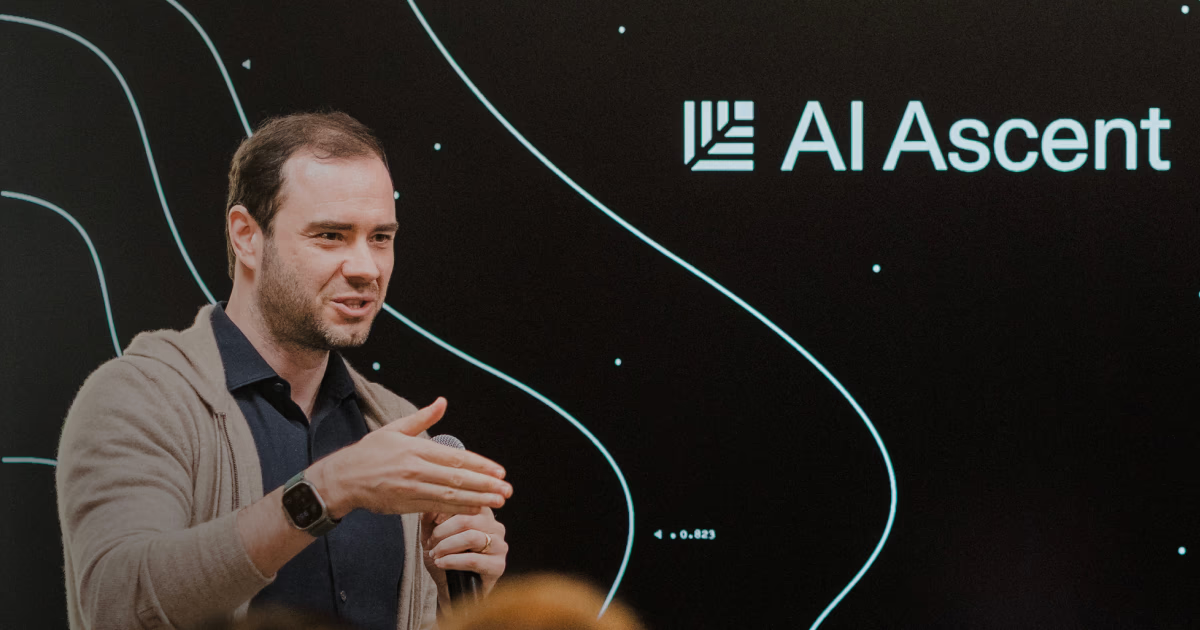 Sequoia's AI Ascent 2026 framed this year as the "year of agents" and a shift from selling software to selling outcomes. Source: Sequoia Capital
There is a catch nobody can engineer around. An agent that does not know your organisation is, to borrow a sharp phrase, a smart fool. It will write a flawless email in the wrong brand voice. It will answer every general question and miss the one that matters: did we ever fix that bug the client complained about, and did we already reject this idea three months ago?
That realisation has created a small category of startups pitching what they call organisational memory or a context layer, a shared place where a company's decisions, answers, and judgement get captured and reused. Forbes has written about it; tools like Coworker.ai and the recently funded Lucius are early entrants. We would be honest with any client here. The category is promising, not proven. Most of these products handle the high-frequency, repetitive slice of work, not the complex, high-stakes calls. Treat them as a sign of where things are heading, not a saviour.
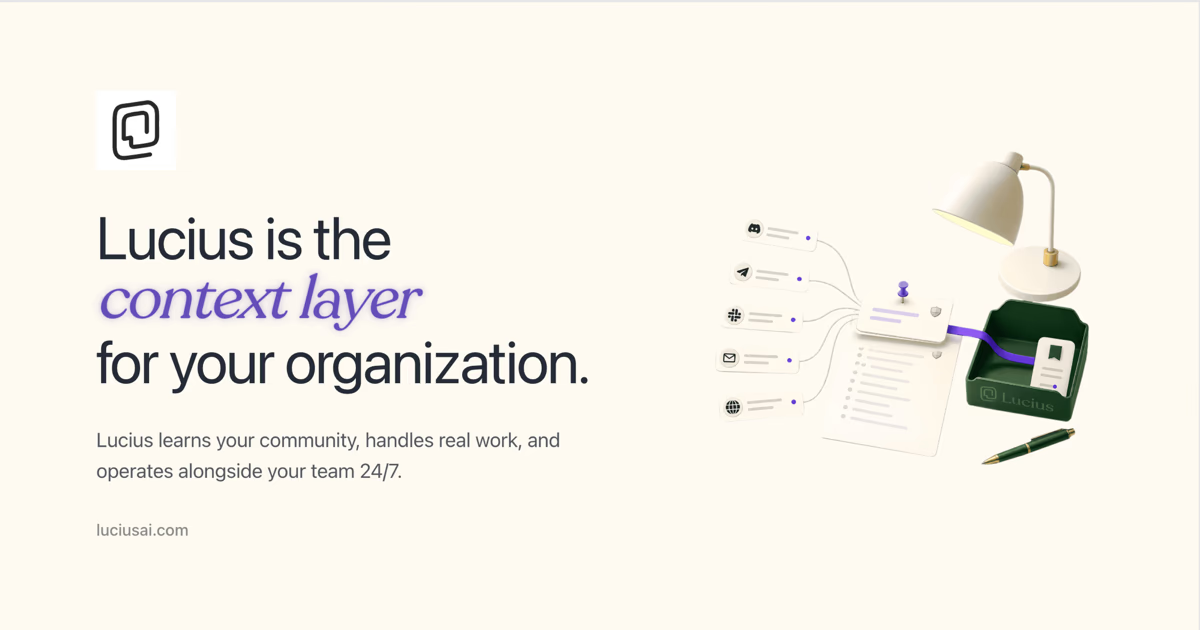 Startups like Lucius now pitch a "context layer" that captures a company's decisions and answers for reuse. Source: Lucius
How Malaysian founders can fix the AI productivity paradox
You do not need to wait for a perfect product, and you should not bet the company on an early one. The principle matters more than any product on the market today, and you can start this month.
Stop counting tool seats. Start building a place to remember. Before you buy your team a tenth AI subscription, check how well they use the ones they have, then ask a simpler question: when someone solves a problem well, where does that answer go so the next person can find it? If the answer is "nobody knows," more tools will only speed up the chaos.
Pick one painful, repeated workflow and make its knowledge reusable. Not the whole company at once. The support question asked twenty times a week. The onboarding a new hire pieces together over a month. Capture how it is actually handled, somewhere searchable, and let AI draw from that.
If you are a team of one, build your own context layer anyway. Your project notes, client conversations, and writing samples are quietly becoming your most valuable asset. We have argued before that the durable skill is knowing what to ask of AI rather than chasing the newest tool. The organisational version of that argument is simple: the durable asset is a memory the tools can draw on.
Our honest take, after three years of watching the AI productivity paradox play out: the winners will not be the companies with the smartest model. Models reset every few months and the moat is shallow. The winners will be the ones with the deepest memory of how they actually work, because that is the one thing a competitor cannot copy or catch up to quickly.
Thinking about how to turn your team's scattered AI use into something that compounds? At Gotchaa Lab we build the custom AI solutions that let AI draw on your real business context, and the software underneath them. Talk to us and we will give you an honest read on what is worth building and what is not.
References
- MIT report: 95% of generative AI pilots at companies are failing (Fortune, coverage of MIT NANDA "The GenAI Divide: State of AI in Business 2025")
- The social economy: Unlocking value and productivity through social technologies (McKinsey)
- AI Ascent 2026 (Sequoia Capital)
- The Role Of Organizational Memory In Scaling Enterprise AI (Forbes)
- Lucius, the context layer for your organization