Trump's AI legislative framework landed on March 20, and it reads like a love letter to the tech industry. Less regulation, fewer state-level headaches, and a clear signal that America wants to win the AI race without red tape slowing things down.
If you're a Malaysian business owner thinking "that's an American problem," hold on. If you use ChatGPT, Claude, or Copilot daily, serve American clients, or compete with US companies, Trump's AI framework will touch your operations sooner than you'd expect.
What Trump's AI framework actually says
The framework asks Congress to create a single federal standard for AI, replacing the patchwork of state-level rules that were making compliance a nightmare. The administration wants to preempt state AI laws that "impose undue burdens" and avoid "fifty discordant" standards.
The copyright position is the one to watch. The White House believes AI training on copyrighted material does not violate copyright law, though it defers the question to the courts rather than asking Congress to settle it. The signal is clear, and it puts the US on a different path from the EU.
The TRUMP AMERICA AI Act takes it further
Two days earlier, Senator Marsha Blackburn introduced a 291-page bill called the TRUMP AMERICA AI Act. Despite the pro-business framing, this one has teeth.
It creates a federal products liability framework where developers can be sued for defective AI design or unreasonably dangerous products. High-risk AI systems would need annual third-party audits focused on detecting viewpoint discrimination and political bias. And the bill says AI training on copyrighted material is explicitly NOT fair use, directly contradicting the White House framework released two days later.
The bill would also repeal Section 230 entirely, which could reshape how AI-generated content is handled online.
How does US AI regulation affect Malaysian businesses?
If you're a Malaysian company using any US-built AI service, the regulatory environment those tools operate under affects you. Here are some real scenarios:
Say you run a KL marketing agency that uses ChatGPT to draft ad copy and Midjourney to generate visuals. If the copyright rules tighten and those models get retrained on a smaller dataset, the output quality could drop overnight. Or imagine you're a Penang software house building an AI-powered chatbot for a US client. If the new federal standard requires content watermarking and third-party audits, your client will expect you to comply, even though you're based in Malaysia.
Or consider pricing. If US AI providers face new liability exposure, they'll pass that cost on. Your team's RM500/month ChatGPT subscription could quietly become RM700.
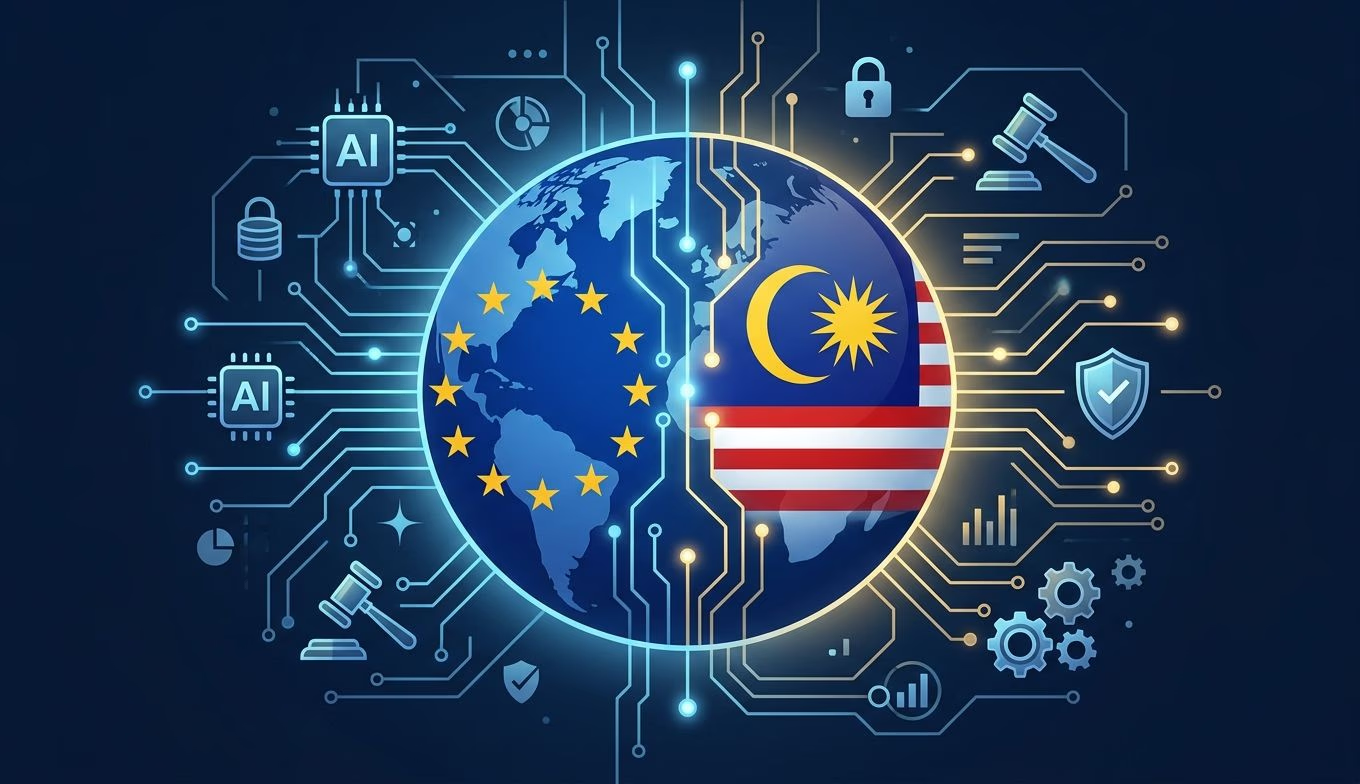
Meanwhile, the regulatory approaches across major markets in Southeast Asia and beyond are diverging fast. Here's how they compare:
| US (Trump framework) | EU AI Act | Malaysia AI Bill | |
|---|---|---|---|
| Approach | Permissive, pro-innovation | Strict, risk-based | Risk-based, innovation-friendly |
| Copyright and training data | Fair use (framework) vs. not fair use (bill) | Opt-out rights for creators | TBD |
| Liability | Limited developer liability | Strict for high-risk AI | TBD |
| Timeline | Proposal stage, 2026 | Enforcing from Aug 2025 | Cabinet by June 2026 |
The EU AI Act is strict. The US leans permissive. Malaysia's AI Governance Bill sits in between, per the National Artificial Intelligence Office (NAIO).
What should Malaysian businesses do now?
Our honest take: don't panic, but don't ignore this. The US framework is a proposal, not law yet. Congress will likely reshape it. But the gap between US, EU, and ASEAN approaches will only grow.
A few things worth doing now:
- List every AI tool your business uses and where the provider is based. This tells you which regulations could apply to you.
- Watch the copyright fight. The White House and the TRUMP AMERICA AI Act disagree on whether AI training on copyrighted content is fair use. However this shakes out, it will change the tools you use.
- Prepare for Malaysia's AI Governance Bill before it arrives mid-2026. If you handle customer data or make automated decisions, a risk-based framework is coming.
We saw this with PDPA. The businesses that prepared early barely noticed when enforcement kicked in. The rest are still catching up.
At Gotchaa Lab, we build AI solutions with compliance in mind from day one. If you're unsure how these changes affect your tech stack, let's talk.
This article discusses regulatory proposals and does not constitute legal advice. Consult a qualified legal professional for guidance specific to your business.