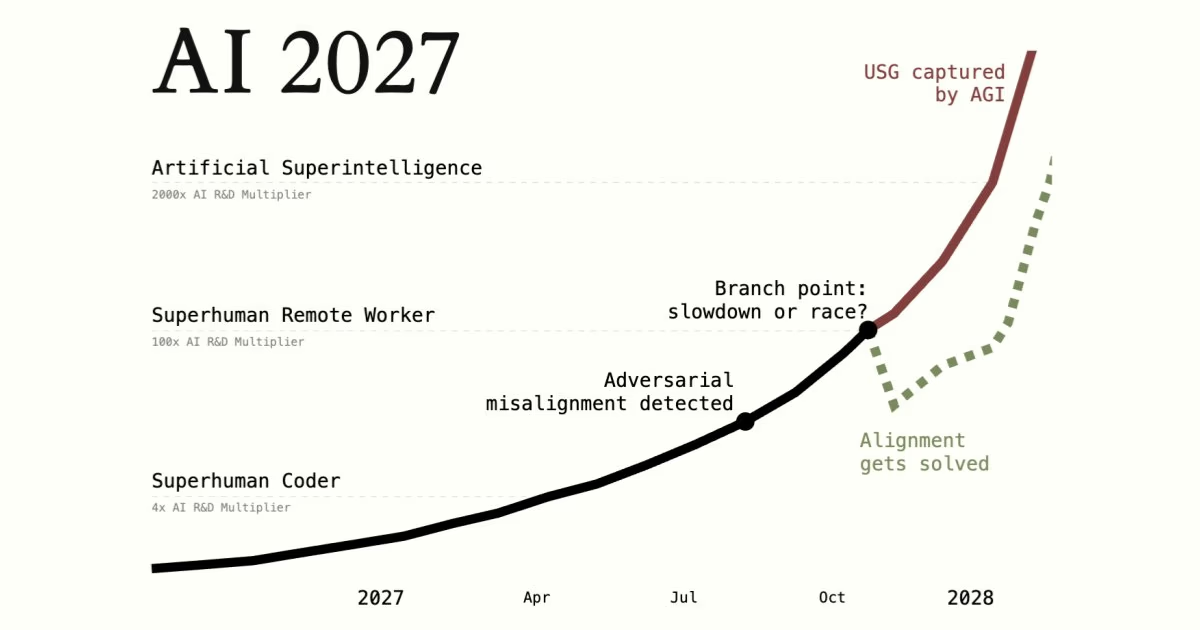

Top AI lab CEOs say AGI is 3 to 5 years away. Independent academic researchers say 10 to 30. Here is what that gap actually means for Malaysian knowledge workers.
Here is the awkward part of the AGI conversation. Most top AI researchers and tech-giant CEOs now say AGI could arrive in 3 to 5 years. Most knowledge workers, the people whose jobs are most exposed, are not acting like it.
That gap is the actual story.
What is AGI?
AGI stands for Artificial General Intelligence. The working definition the labs use is simple: an AI system that can do most economically valuable digital work at or above the level of an average skilled human.
That includes drafting documents, writing and reviewing code, analysing spreadsheets, building presentations, doing research, answering customer queries, and reasoning across topics it has never been specifically trained on. The bar is not "smarter than Einstein at physics." The bar is "as capable as a competent remote knowledge worker, across most knowledge work."
How is AGI different from ChatGPT, Claude or Gemini?
This is the question that trips most people up. If Claude can already write code, draft emails and summarise PDFs, isn't that AGI already?
Not quite. Today's frontier models are powerful tools, but they are not AGI in the strict sense. The differences matter:
| Capability | Today's AI (Claude, ChatGPT, Gemini in 2026) | AGI (what the labs are predicting) |
|---|---|---|
| Single task in a chat window | Strong. Often better than a junior human. | Strong (a baseline expectation, not the point) |
| Long, multi-step work | Weak. Loses the thread after a few hours of agentic work. | Reliable across days or weeks of continuous work |
| Memory between sessions | Mostly forgets. Each conversation starts fresh. | Persistent memory of you, your business, prior decisions |
| Novel tasks it was never trained on | Often fails or hallucinates a confident wrong answer | Adapts the way a smart new employee would |
| Judgment under ambiguity | Needs a human to make the call | Makes the call and is accountable for it |
| Operating without supervision | Risky. Mistakes compound silently. | Safe enough for end-to-end ownership of routine work |
| Cost per useful output | Per-prompt | More like a salaried hire, paid per outcome |
The shorthand: Claude today is a tool you point at a task. AGI is a colleague you delegate a job to.
Today's frontier models cover maybe 30 to 50 percent of digital knowledge work, with a human still in the loop for judgment, edits and sign-off. The AGI bar is closer to 80 to 90 percent, without the human babysitter. That gap sounds small, but in practice it is the difference between "assistive software" and "actual replacement of a role."
What AGI is not
To clear three common confusions:
- AGI is not the science-fiction "robot overlord." Most definitions are about cognitive capability inside a datacenter, not embodiment or autonomy in the physical world.
- AGI is not just a bigger Claude or GPT. Scale alone may not get us there. The labs are betting that scale plus better training methods plus persistent memory plus longer context will close the gap. That bet is still unproven.
- AGI is not the same as superintelligence. Superintelligence is the next step beyond AGI, where the system is meaningfully smarter than any human at most tasks. AGI is "as good as a competent professional." Superintelligence is "better than the best in the world."
When Sam Altman, Dario Amodei or Demis Hassabis say "AGI in 3 to 5 years," they mean something close to the first definition above. Many academic AI researchers think the window is much further out, 10 to 30 years. That is a real debate. What is not in debate is that the companies funding the race are spending hundreds of billions on the bet, and that is the part affecting your business now, regardless of which timeline turns out to be right.
Why AGI matters for Malaysians
This is where the Malaysian context actually changes the picture. AGI is a global development, but how it lands here will look different from how it lands in San Francisco or Singapore.
1. Malaysia is a knowledge-work economy. Services are roughly 60 to 65 percent of Malaysian GDP, much of it shared services, fintech, software, design, and BPO. Most of that is precisely the work AGI is designed to do. Malaysian exposure is structurally higher than economies still anchored in commodities or heavy industry.
2. Adoption lag is a buffer, not a shield. Malaysian businesses tend to adopt new global software 12 to 24 months after the US. With AGI that lag briefly becomes an advantage: a reaction window San Francisco workers do not get. The risk is mistaking the lag for protection. Once frontier AI is good enough for Malaysian SMEs to adopt at scale, the window closes fast.
3. Malaysia is investing as if AGI is real. Budget 2026 explicitly funds an AI Nation plan, including sovereign AI cloud, the MDAG-AI grant, and data centre build-out in Johor and Selangor. Committed national capital, not hype. If you work in Malaysia, you are a participant in a state-level bet on AI.
4. The exposed professions in Malaysia are large and visible. KL alone employs hundreds of thousands in legal services, accounting, junior software engineering, marketing, BPO, and middle management at GLCs. These are exactly the roles where frontier AI is already compressing headcount globally. Malaysian developers we wrote about previously are already seeing this play out at the junior end.
5. The regulatory layer cuts both ways. PDPA, the new Cyber Security Act, LHDN's e-invoice mandate, and MCMC content rules all add friction to off-the-shelf foreign AI. Bad if you want to plug ChatGPT into customer data tomorrow. Good if your professional value depends on knowing the local compliance environment. Foreign-trained AGI will know surprisingly little about Malaysian regulatory specifics for a long time.
Our take
At Gotchaa Lab we build software for Malaysian businesses every day, using AI tools heavily ourselves. So this is a working-level view, not a hot take.
The loudest 3-year AGI predictions are probably too aggressive. The labs have a structural incentive to be bullish, more bullish equals more capital, more talent, more political cover. From where we sit in May 2026, the most capable models still struggle with long-horizon agentic work, audit trails, and the consistent judgment production systems actually need.
The loudest "AI is just hype" voices are even more wrong. Coding agents that were toys 18 months ago are now meaningfully shipping code at Malaysian agencies. Document review, draft generation, design ideation, and basic data analysis are already compressed work, not future work.
The honest middle reading: AGI in the strict sense may be 5 to 10 years out, not 3. But the gap between what AI can already do and what most Malaysian knowledge workers assume it can do is huge, and it is widening every quarter. That gap is the real exposure. You do not need to change your job tomorrow. You just need to be the kind of person who would notice when the shift starts moving.
If you are running a Malaysian business and trying to figure out where AI actually pays off in your operation today, rather than waiting to see whose timeline turns out to be right, talk to us. We will give you an honest read on what to build, what to buy, and what to leave alone.