

Earlier this year we wrote about Hermes Agent overtaking OpenClaw at #1 on OpenRouter. Since then, the most common follow-up question from Malaysian business owners has been the practical one: Yes, but what would I actually use it for?
This guide is the answer. Below are five realistic Hermes Agent use cases for a Malaysian SME today, three things it will fail at, and what setup and running it actually costs in ringgit. No hype. Just what we have seen work (and not work) on real client engagements.
What is Hermes Agent, in one paragraph
Hermes Agent is a free, open-source AI agent from Nous Research. You install it on a small server (a VPS), connect it to a chat app like Telegram or WhatsApp Business, and give it goals in plain English. Unlike ChatGPT, it actually does the work: it reads files, calls APIs, runs scheduled jobs, and remembers what it learned last time. We covered what it is and why it hit #1 in our earlier Hermes post, and the tool-versus-agent distinction in our ChatGPT connectors piece.
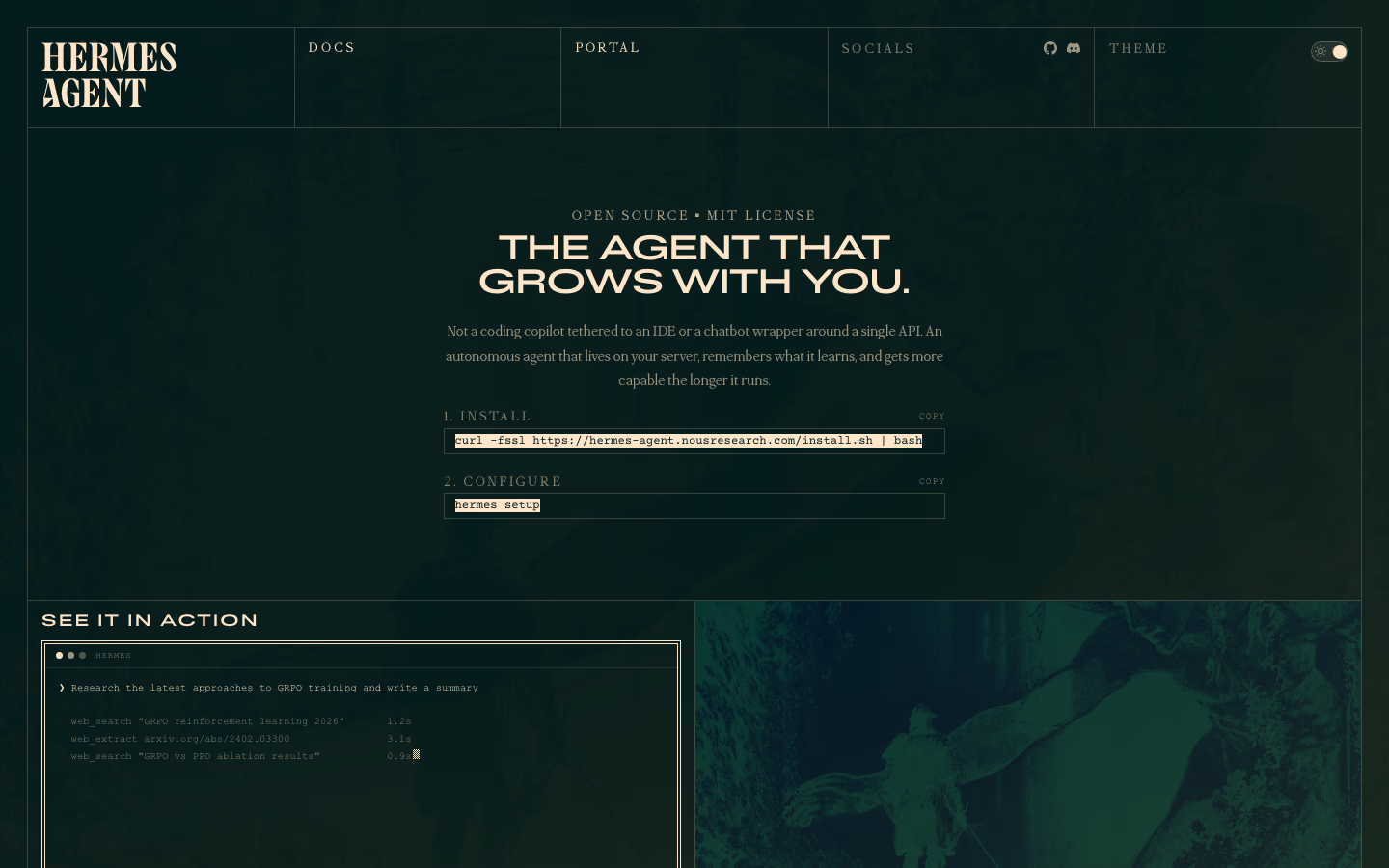 The Hermes Agent product page. Open source, MIT licensed, runs on a small server. Source: hermes-agent.nousresearch.com.
Hermes Agent use cases that actually work for a Malaysian SME
1. Auto-reply that sounds like you write it
Hermes reads your last few hundred sent emails, learns your tone, your usual phrasing, and how you handle each type of message. From day two onwards, every incoming email arrives with a draft reply already written in your voice. You skim, edit if needed, send. Across a team this pays back the setup cost in under a month.
2. PowerPoint proposals drafted from a brief or a PDF
Drop a client RFP, an email thread, or five lines about a new lead. Hermes generates the full pitch deck (cover, problem, scope, pricing options, timeline, team) in your firm's template. You spend your time on the slides that need judgment, not on assembling the structure from scratch.
3. Bulk lead research that targets the right customer
Give Hermes your ideal customer profile (industry, headcount, location, recent signal like a funding round or a hiring spree). It scans 50 to 100 companies overnight, scores each one against the profile, and hands you a ranked Google Sheet with the top 20 plus a named decision-maker and an opening line for each. Your sales team starts Monday with a hot list, not a research project.
4. Internal Q&A bot trained on your handbook
Staff stop pinging the boss for the same questions every week. They WhatsApp the agent instead. "Can I take half a day next Tuesday?" "Discount tier for a RM 80k order?" "Refund policy on damaged goods?" Hermes answers from your SOPs, with a link to the source paragraph so staff can verify.
5. Competitor price alerts that fire on time
Hermes watches your competitors' Shopee, Lazada, or Shopify pages every morning. The moment a price moves by more than 10% or a SKU goes out of stock, it pings your sales lead on WhatsApp. You react inside the hour, not next week.
Hermes Agent use cases to avoid (and why)
Three things to keep firmly off the agent's plate.
1. Anything where one wrong output costs you money. Do not let Hermes submit e-invoices to MyInvois on its own. Do not let it post final replies to a high-stakes customer complaint. Do not let it sign anything. It can draft and propose; humans approve, which also catches orders slipped into an email before they go out. The reason is auditability: if LHDN or PDPA asks who made a decision, "the AI agent" is not an acceptable answer.
2. Customer-facing chat without strong guardrails. Hermes is good at staff-facing replies and good at first drafts. It is not yet good at being the public face of your brand on Instagram DMs unsupervised. We have seen Malaysian founders try this and walk it back within a month after one odd reply went screenshot-viral. Use it to draft, not to send.
3. Long, judgment-heavy decisions. "Should we expand to Penang?" is not an agent job. "Pull the numbers that would inform that decision and flag what is missing" is. Use Hermes to assemble the evidence, not to make the call.
A construction site put Hermes on its WhatsApp: what it can and cannot safely do
The clearest version of this pattern comes from the Hermes community itself. A contractor wired the agent into the WhatsApp group that runs a live site: the daily back-and-forth between the supervisor, the subcontractors, and the material suppliers.
What it handled well. Every morning it read the overnight messages and posted a clean summary of who is on site, which deliveries are confirmed, and what is blocking work. When a supplier sent a delivery order as a photo, it logged the item, quantity, and date into a shared sheet so nobody retyped it. When a subcontractor asked which unit to work on, it answered from the schedule instead of waiting for the supervisor to wake up. By week two it knew the crew names, the supplier list, and the site's shorthand. That is the persistent memory paying off.
Where a human stayed in charge. It never approved a variation order or confirmed a payment. It flagged a changed price on a delivery note and asked a person to check it, rather than accepting it. That is the whole lesson. On a site, a wrong "yes" costs real money or a real injury, so the agent triages and records while a human decides. The PDPA point applies here too: worker phone numbers and supplier pricing are personal and commercial data, so mind the model choice and the audit log before you switch it on.
How to run Hermes Agent (and what it costs)
You do not need a developer. OpenRouter offers a hosted Hermes Agent that spawns in your account in about 60 seconds. No servers, no command line, no API key juggling.
→ Spawn Hermes Agent on OpenRouter (free, 60 seconds)
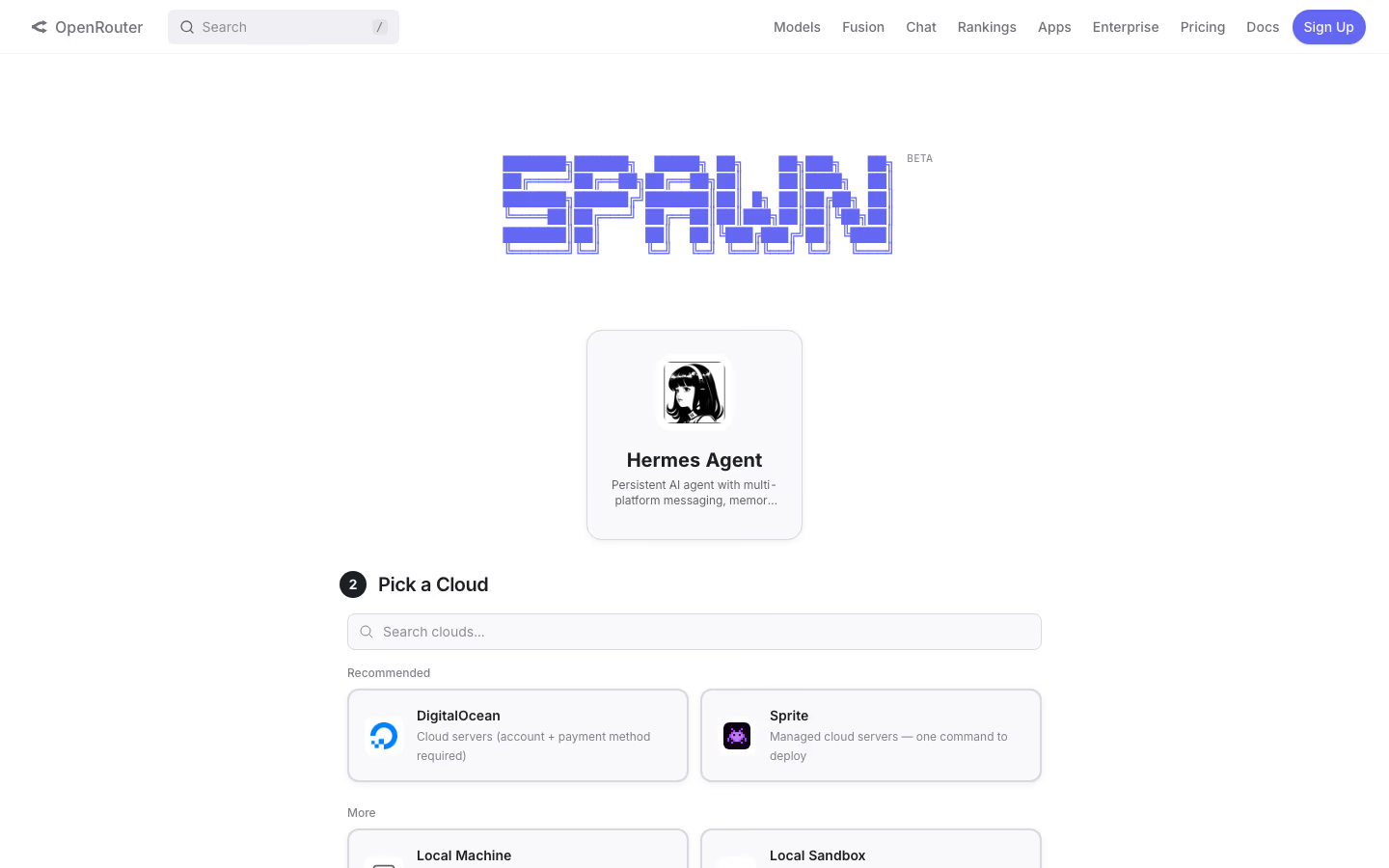 The OpenRouter Spawn page. Pick a cloud, click once, and your Hermes Agent is live in under a minute. Source: OpenRouter Spawn.
What it costs: the spawn is free, and OpenRouter charges only for the model the agent calls. Cheap models (DeepSeek V3, Qwen 3.6, Gemini Flash) handle internal Q&A, auto-reply, and lead research at around RM 20 to RM 80 a month. Premium models (Claude Sonnet 4.6, GPT-5.4) run RM 200 to RM 500 at heavy use, and you only need them for high-stakes drafting like client proposals. For a typical Malaysian SME the realistic bill on the 1-click route is around RM 50 a month. If your sector is healthcare, financial services, or legal, self-host instead on a local VPS (Exabytes, ServerFreak, AIMS Data Centre): roughly RM 80 to RM 200 a month plus a one-time setup of RM 4,000 to RM 12,000. The next section explains why.
PDPA and audit trail, the part founders forget
Two things to lock down before Hermes touches a real workflow.
First, data residency. If Hermes reads customer emails and you wire it to GPT or Claude through OpenRouter, that data leaves Malaysia. Under the 2024 PDPA amendment and the April 2025 Cross-Border Data Transfer Guideline, that is acceptable only if you give customers a written notice naming the class of overseas recipients and the AI processing purpose, and record their explicit consent. A buried privacy-policy clause is not enough. Regulated sectors (healthcare, financial services, legal) may need a local model on a Malaysian-hosted VPS instead. Our data centre piece on NextDC KL1 covers residency in more depth.
Second, audit trail. Every action Hermes takes should be logged: who instructed it, when, what data it read, what it did, what a human approved. Without that log, you cannot answer a PDPA breach inquiry or an LHDN query. It is the unglamorous part of an AI rollout and the part rushed deployments skip.
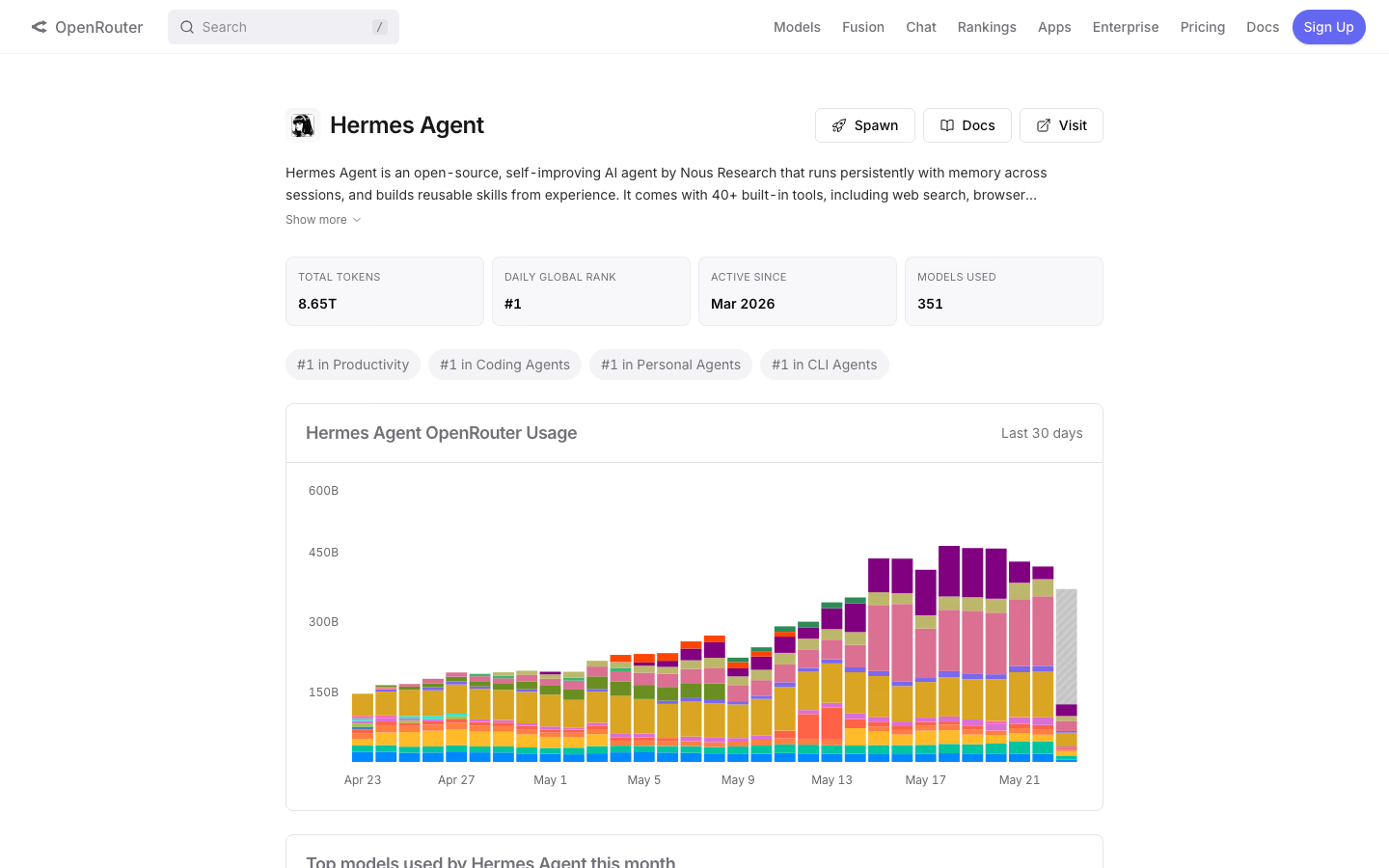 Hermes Agent's live OpenRouter dashboard as of late May 2026. Still #1 daily, with 8.65T tokens processed since launch. Source: OpenRouter.
Our take
Hermes is the first widely-used AI agent genuinely worth installing for a Malaysian SME. Not because it is smarter than ChatGPT, but because it remembers your business and runs on its own schedule. Instead of paying for a tool that forgets you every conversation, you are training an asset that gets more useful over time.
The construction-site example shows both halves of that in one picture: the agent is brilliant at reading, summarising, and logging, and dangerous the moment it approves something on its own. So pick one low-risk use case (we usually start clients with #1 or #4), build it properly, prove value over two months, then add the next. The mistake we see most is founders who pay for a fancy setup that does five things badly instead of one thing well.
If you want to talk through which use case fits your business, WhatsApp us. We will give you an honest take in 15 minutes, no sales pitch. Or browse our AI solutions work to see what we have shipped.
This article is general guidance and does not constitute legal or financial advice. PDPA compliance specifics depend on your sector and data flows. Verify with a qualified adviser for regulated industries.
References
- Spawn Hermes Agent on OpenRouter (1-click)
- Hermes Agent on GitHub (Nous Research)
- Hermes Agent product page
- Hermes Agent on OpenRouter
- OpenRouter App and Agent Rankings
- Malaysia Personal Data Protection Department (JPDP)
- Cross-Border Personal Data Transfer Guideline (JPDP, April 2025)
- Hermes community thread: running a construction site's WhatsApp