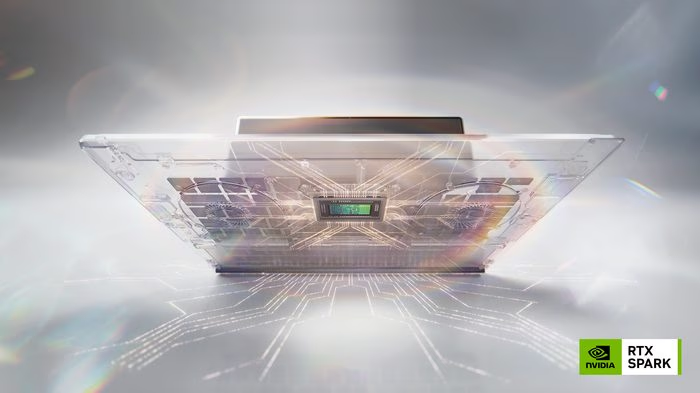
NVIDIA just announced the RTX Spark, a new superchip that puts what it calls an "AI supercomputer" inside ordinary Windows laptops and small desktops. NVIDIA built it with Microsoft and showed it off at Computex in Taipei. The pitch is simple: a PC powerful enough to run a serious AI model on the device itself, no cloud connection required.
The headline writes itself. But the specs are not the story. The story is the shift: AI is moving off the cloud and onto the machine in front of you. That matters for any Malaysian business handling sensitive data or paying a growing cloud AI bill. Here is our honest read.
What is the NVIDIA RTX Spark?
RTX Spark is a chip, not a single gadget. NVIDIA fuses two parts into one "superchip": a 20-core Grace Arm CPU (co-designed with MediaTek) and a Blackwell GPU with 6,144 graphics cores. Add up to 128GB of unified memory and you get about one petaflop of AI compute. That is enough to run a 120-billion-parameter AI model, with a one-million-token context window, entirely on the laptop.
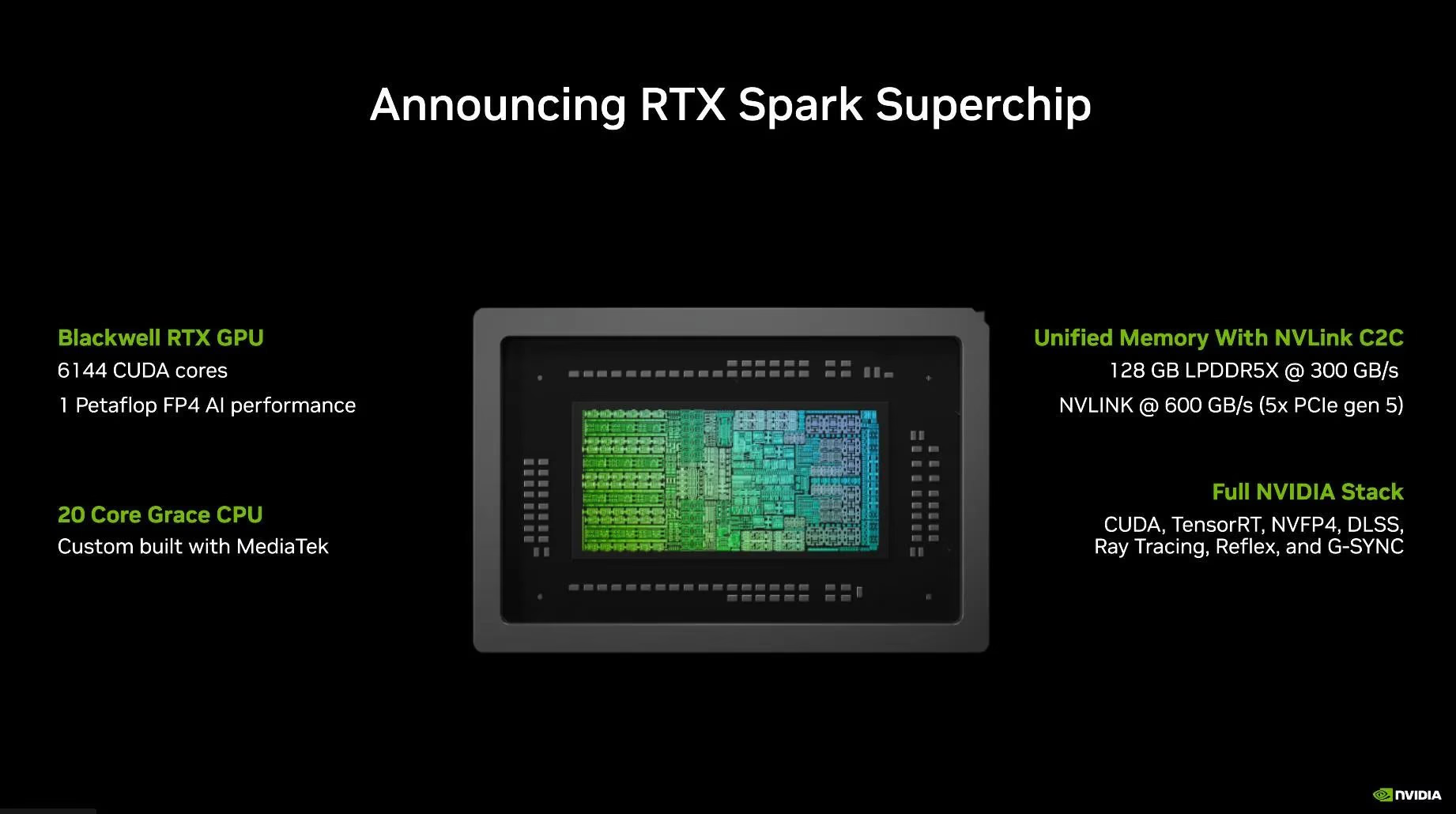 The RTX Spark Superchip pairs a Blackwell GPU with a 20-core Grace CPU and 128GB of unified memory. Source: NVIDIA (via VideoCardz)
The machines run Windows on Arm and qualify as Copilot+ PCs. The deeper part of the deal is software. Microsoft is adding new Windows security rules and a runtime that lets AI agents act on your PC under your control, with the agent built right into the taskbar. Dell, Lenovo, HP, ASUS, MSI, and Microsoft Surface plan to ship RTX Spark devices in Fall 2026.
One clarification, since the names confuse people: this is not the DGX Spark, NVIDIA's earlier AI box for developers. RTX Spark is a consumer and business platform that also games and edits video. Same family, different product.
On-device AI vs cloud: why this matters for business
Today, almost every AI tool a Malaysian business uses runs in the cloud. You type into ChatGPT or Claude, your text travels to a data centre overseas, and the answer comes back. On-device AI flips that: the model runs on your own hardware, so your data never leaves the room.
That difference is mostly about privacy and control, not speed. As IBM puts it, edge AI "keeps sensitive data locally, on the device where it's gathered, stored and processed," while cloud AI moves it over networks where exposure is higher. For regulated work, that is the whole ballgame.
RTX Spark is the consumer-friendly, Windows version of a trend that is already here, now backed by the two biggest names in PCs.
What this means for Malaysian businesses
The honest part first: RTX Spark ships in Fall 2026, has no announced price, and starts at the premium end. The Windows agent stack is also new and unproven in real offices. This is not a buy-now decision.
The reason to pay attention is concrete. Picture a KL law firm that wants an AI agent to read and summarise confidential case files. Today that means sending client documents to a cloud model overseas, which for many firms is a contract or PDPA non-starter. On an RTX Spark machine, the same agent runs on the laptop and the files never leave the office. The blocker disappears. The same goes for a clinic handling patient records or a finance team working with customer data.
There is a cost angle too. A team leaning on Claude or ChatGPT all day can run up thousands of ringgit a month in subscriptions and API fees, every month. A capable on-device machine is a one-time cost. For a small team doing constant, sensitive AI work, owning the hardware can pay for itself inside a year. For light or occasional use, the cloud still wins easily. We ran this same math for KL agencies buying Mac Studios.
So what should you do now, with nothing to buy yet?
- Map your data. List what can legally go to the cloud and what cannot. That one split tells you whether on-device AI is even relevant to you, and it is useful work either way.
- Flag your blocked projects. The AI ideas you parked because the data could not leave the building are exactly what RTX Spark could unlock in 2026.
- Keep using the cloud for everything else. For general work, Claude and ChatGPT stay cheaper and faster. This announcement changes none of that today.
Choosing when local AI beats cloud AI comes down to cost, compliance, and how you actually work. The chip is the easy part. Fitting it into a real business is the part worth getting right.
At Gotchaa Lab, we help Malaysian businesses make these calls without the hype. If you are weighing on-device AI against cloud tools for sensitive work, talk to us and we will give you an honest take, no sales pitch.
This article is for general information only and does not constitute legal or financial advice. Cost figures are illustrative estimates and will vary by use case. Verify your PDPA obligations with a qualified advisor.
References
- NVIDIA and Microsoft Reinvent Windows PCs for the Age of Personal AI
- Nvidia launches RTX Spark superchip (The Star)
- Nvidia announces RTX Spark as 'the most efficient PC chip ever built' (The Verge)
- Nvidia unveils RTX Spark Superchip for laptops and desktop PCs (Tom's Hardware)
- Edge AI vs. Cloud AI (IBM)