
A forward deployed engineer is a software engineer who works inside your company instead of from a vendor's office. They join your meetings, use your live data, and build against the workflows they can see with their own eyes. The role started at Palantir and is now standard at OpenAI, Anthropic and Google Cloud.
Gotchaa Lab recently placed one of our engineers full-time inside a Malaysian B2B software company. Not a project, not a support retainer. One person in the building, with a mandate to make that engineering team faster using AI.
Here is how the first weeks went, and why this is a bad purchase for most companies.
What is a forward deployed engineer, exactly?
The label is new, the job is not. What separates a forward deployed engineer from a software engineer is the direction the specification travels. A contractor receives a brief and builds it. A forward deployed engineer writes the brief, because nobody inside the company has managed to yet. Half the work is engineering and the other half is watching how the place actually runs, which is never how the org chart says it runs.
Job listings for the role grew more than 700% year on year, and OpenAI launched a whole deployment company around it in May 2026. AI models are general, businesses are specific, and somebody has to go sit in the specific mess.
Why we stopped writing proposals for this kind of work
Our answer to "help us use AI" used to be a scoped proposal. Discovery workshop, requirements doc, fixed price, delivery date. It kept producing the wrong thing, and the failure was never the estimate. You cannot scope what you have not seen.
A client asks for a chatbot, you quote a chatbot, you deliver a good chatbot. Six months later the thing actually slowing their team down is untouched, because it was never in the brief.
So the discovery is the project. Scope it from outside and you get the wrong answer at a reasonable price.
What the first weeks actually look like
Four steps, in this order.
Write the company down. Before touching code, the engineer builds a private record of how the place really works. Who decides what. Which past project left a scar. Which team quietly does not trust the tooling. None of that is documented.
Read the company's own data. Bug tracker history, ticket ageing, deploy frequency, where defects cluster. Companies often misdiagnose where their engineering time goes, and a survey will just repeat the misdiagnosis back to you.
Then sequence the rollout, politics included. Order matters more than tools. Giving every engineer an AI licence on day one is how you get an expensive subscription nobody opens. Access that people earn gets used.
Ship one pilot with a number attached. Small enough to finish, specific enough to measure.
We are early in this engagement, so we have no outcome numbers yet. When the ninety-day metrics land we will publish them.
Forward deployed engineer cost and salary in Malaysia
Four ways to buy this work locally.
| Option | Typical Malaysian cost | What you actually get | Best when |
|---|---|---|---|
| Enterprise transformation project | From RM180,000 per project | Strategy, roadmap, governance documents | The board needs a defensible plan |
| Local AI agency pilot | RM40,000 to RM180,000 | One working tool, delivered | The problem is already clearly named |
| Embedded engineer, monthly | RM15,000 to RM25,000 | Diagnosis plus delivery, adjusted as you learn | Nobody can yet say what to build |
| In-house AI lead salary | RM25,000 to RM35,000 monthly, loaded | Full attention, knowledge stays | You can find and keep that person |
Watch the units. The first two rows are one-off project prices, the last two are monthly. A six-month embed totals RM90,000 to RM150,000, agency pilot territory, and a year-long one costs what the enterprise project does.
That last row is still the real competitor. If you can hire a strong AI engineering lead, hire them. That person is scarce here. In AWS research published in 2025, 52% of Malaysian businesses named a lack of skills as their biggest barrier to AI adoption. A vacancy you cannot fill costs more than a retainer you can start on Monday.
When not to hire a forward deployed engineer
Three situations where an embed is the wrong buy.
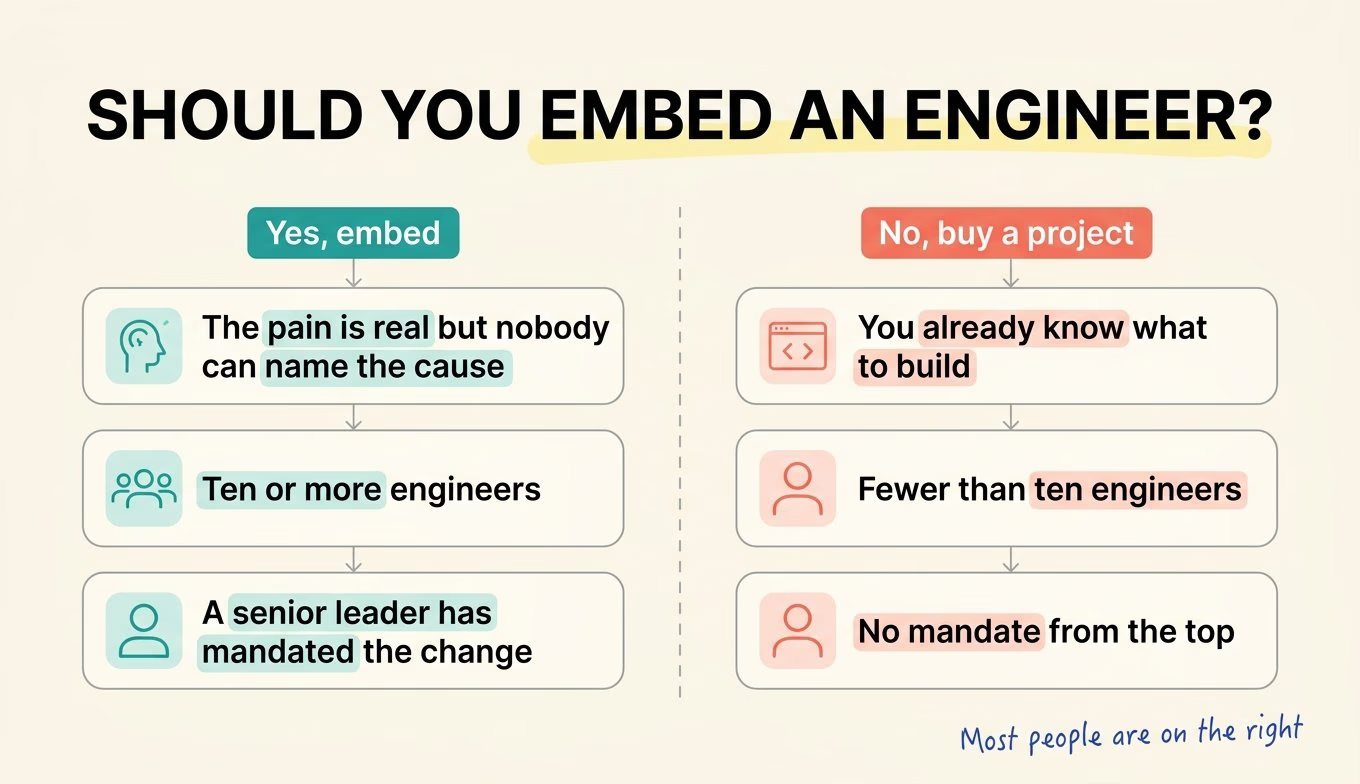 Most companies asking us belong on the right.
You already know what to build. You are paying discovery rates for a known answer. Buy the fixed-scope project instead. It costs less and finishes sooner, and our custom software cost guide covers that route.
Your engineering team is under about ten people. There is not enough process to restructure. At that size the bottleneck is usually one architecture decision, not an adoption programme.
Nobody senior has mandated it. Without a decision maker who has said out loud that the way of working must change, an embedded engineer becomes a well-paid observer who cannot touch what they can see.
One fair objection: a four-week discovery sprint does most of steps one to three for far less. If your team can act on the findings alone, buy that instead. The embed earns its keep when the building is also the hard part.
So the model works when the pain is real, the cause is unclear, and someone with power wants it fixed. Outside that, something cheaper does the job.
We now sell this as a service, and it starts with a process audit rather than a retainer. Thinking about how AI fits into your engineering team? Let's chat. We will tell you honestly if the answer is no.
Cost ranges here are estimates from publicly reported market rates, not financial advice. Actual figures vary by scope and seniority.