Ask your team if they use AI and most will say yes. That answer tells you almost nothing. The AI skills gap is the difference between having AI tools and having staff who can use them well on real work, and a new survey has put numbers on the AI skills gap in Malaysia.
What the IIAM report found about the AI skills gap
The Institute of Internal Auditors Malaysia (IIAM) and recruitment firm Hays Malaysia published The Inside Story of Internal Audit Malaysia 2026 this month. It surveyed internal auditors and audit heads across banking, manufacturing, government-linked firms and more.
Two numbers sit side by side in its AI chapter:
- 69.9% of organisations have adopted AI or advanced analytics in their internal audit work.
- 81% of internal auditors name data analytics and AI as the single most important skill they still need to develop.
The report sums it up in one line: "Adoption has moved faster than capability."
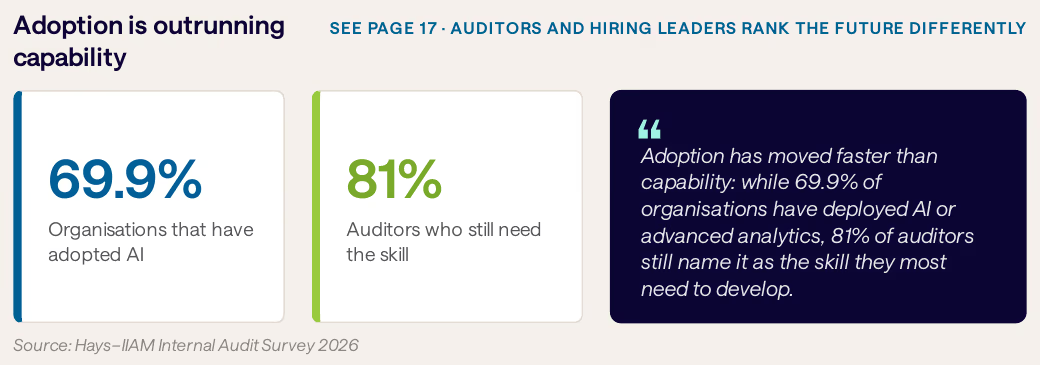 The report's own summary of the gap. Source: The Inside Story of Internal Audit Malaysia 2026, IIAM and Hays Malaysia
What they use it for matters too. Among teams already using AI, 48.1% use it mainly for data analysis and audit testing. Another 32.4% use tools like Microsoft Copilot and Power BI for reports and documentation. Continuous monitoring, forecasting and generative AI "remain relatively limited."
Why the AI skills gap matters even without an audit team
A caveat: the survey covers internal auditors only, and doesn't say how many people answered. What follows is our reading.
We think it carries over because internal auditors check things for a living. If that group says the tools arrived before the skill did, a sales team that got ChatGPT accounts in January is probably in the same spot.
We see this often with SMEs. The owner hears "we use AI" and pictures hours saved, when in practice someone is tidying up emails with ChatGPT. That's fine, but it isn't the same as a quotation that used to take a day now taking an hour. We've covered why one person's AI speed doesn't make the company faster; this is the step before: finding the real speed.
How to measure your team's AI skills gap
You don't need an audit, just four questions about one real task.
| Ask | A weak answer | A strong answer |
|---|---|---|
| Which task do you use it for? | "Lots of things" | "Drafting replies to quotation requests" |
| How long did it take before, and now? | "Faster, I think" | "About 40 minutes, now 15" |
| Who checks the output before it goes out? | "It's usually fine" | "I check prices and names against our system" |
| What does it get wrong? | "Nothing much" | "It makes up delivery dates, so I always fix those" |
The last question is the best test. People who use AI well know where it fails, because they've caught it failing. "Nothing" usually means they haven't looked.
Then take the task with the clearest before and after, write down the steps that person follows, and have a colleague try them. If it only works for one person, it's a personal habit, not a process yet.
Our take: the tool is cheap, the checking isn't
The report says AI is "unlikely to replace professional judgement," and we agree. Among teams that haven't adopted AI, 32.1% named budget as the main barrier. But a Copilot licence is the cheap part. The expensive part is the hours someone spends learning where the tool goes wrong.
That's why employee AI training alone rarely closes the gap: a class gives awareness, and skill comes from using AI on real work and checking the result. If you're weighing one, here's when a government AI course is worth it.
We use AI every day to build software, and much of that time goes to checking its output. If you want AI built into a real workflow with the checks included, see our AI solutions or talk to us. We'll tell you honestly whether it's worth building.