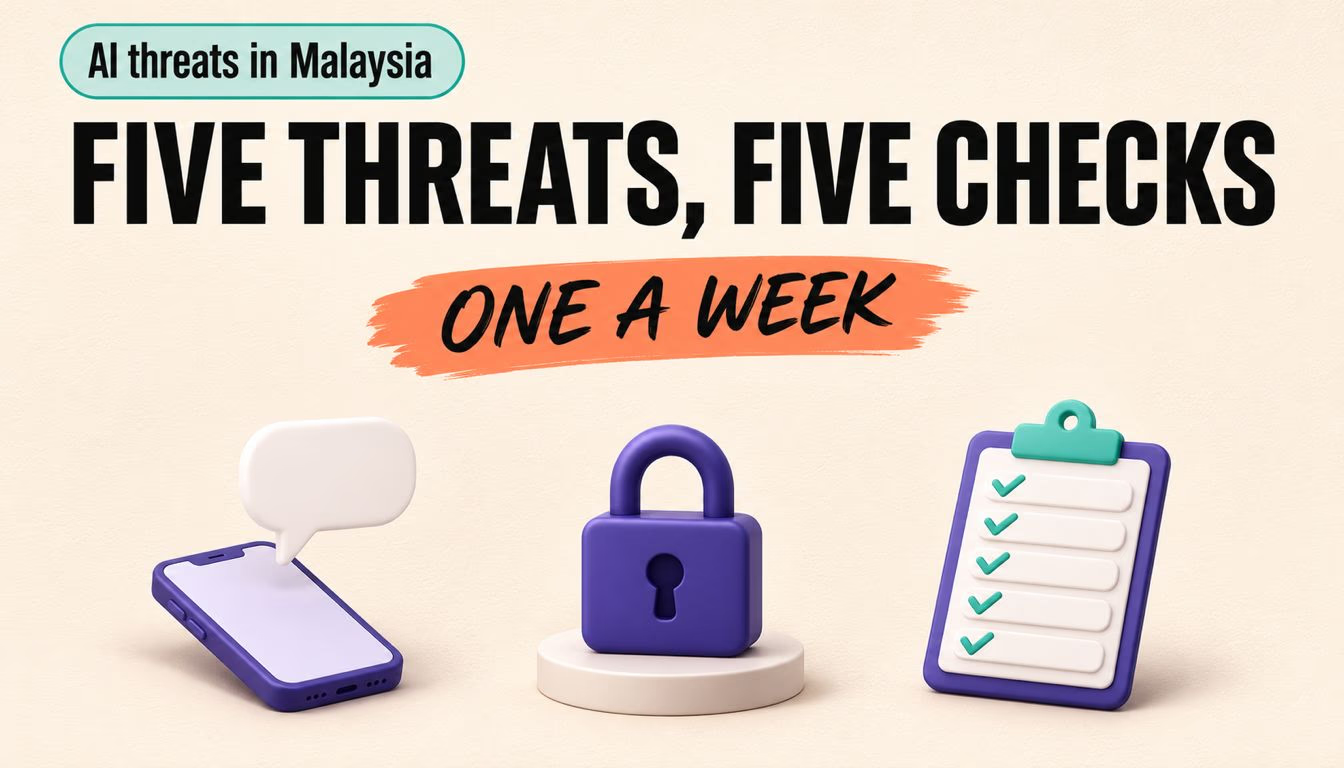
AI threats in Malaysia now have a short list from expert roundtables. According to the New Straits Times on 16 November 2026, a series of AI safety and security roundtables with local and international experts named five: deepfakes, cyberattacks, data privacy breaches, algorithmic bias and the misuse of generative AI.
AI Malaysia organised the roundtables as part of building the National AI Action Plan 2026-2030. In our view, most of it lands first on small firms with no IT person.
What are the five AI threats in Malaysia?
The five are deepfakes, cyberattacks, data privacy breaches, algorithmic bias and the misuse of generative AI. The National Artificial Intelligence Office (NAIO) said, as reported by NST, that the action plan accepts that regulatory oversight alone "would not be sufficient," and proposes an AI Trust Function to assess, monitor and respond to AI threats.
NAIO also said Malaysia has no AI-specific law yet. The AI Governance Bill is still being drafted, and there is no list of banned AI uses. Until then, the existing AIGE guidelines, which MyGOV describes as voluntary, set out principles, and AI used for crime stays under existing cybercrime and communications laws.
NAIO put its focus this way: "ensuring that humans and institutions retain clear control, oversight and accountability over how AI is developed and used." The same rule works in a ten-person office.
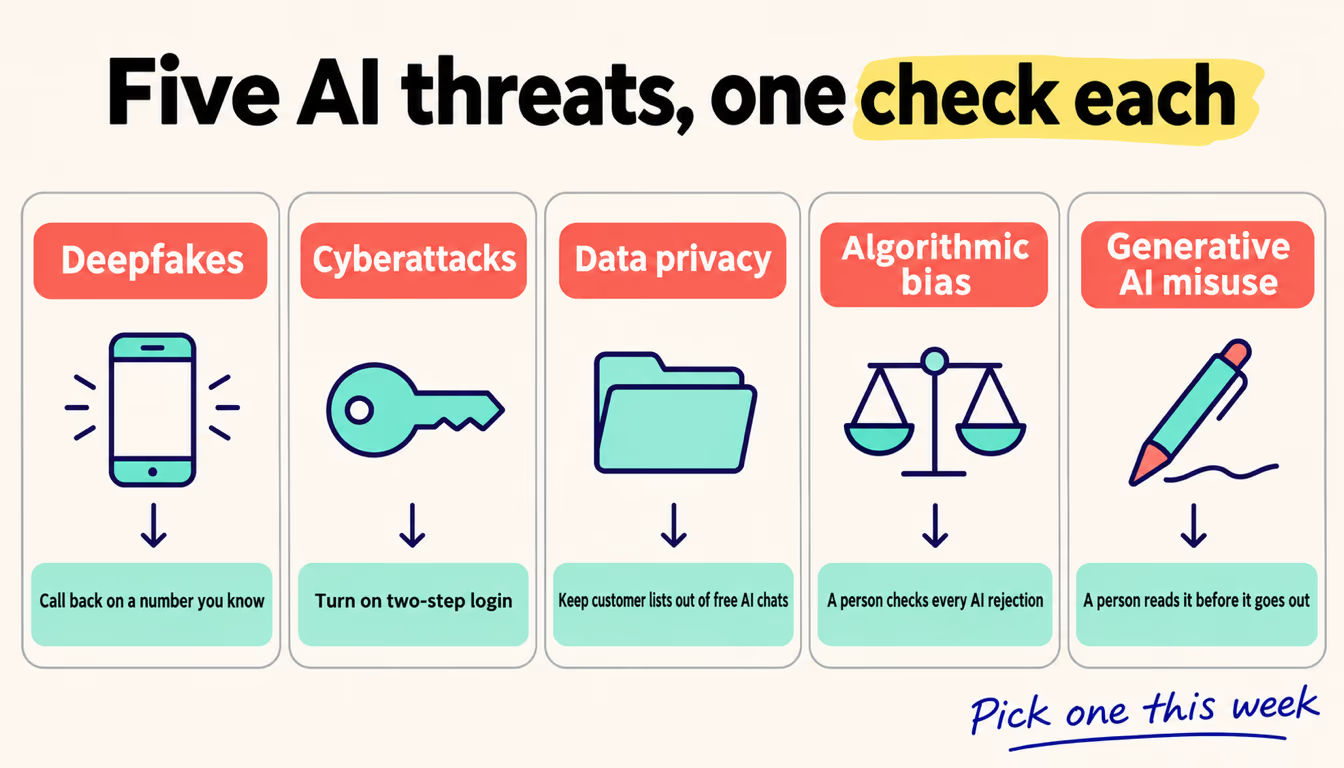 One check per threat. You do not need all five this week.
What the AI threats in Malaysia mean for a small business
1. Deepfakes: call back before you pay
The office version is a voice note or video call from "the boss" or a supplier asking for an urgent transfer. This is the AI voice scam Malaysians search for.
How do you tell if something is an AI scam? Often you can't, by ear. Set one rule: any money request that arrives by voice, video or chat gets a call back on a number already saved in your phone. Scammers pose as businesses too, so give customers one official WhatsApp number.
If money has already gone, call the National Scam Response Centre at 997 straight away.
2. Cyberattacks: turn on two-step login
AI helps attackers write cleaner phishing emails, but they still want your email and banking logins. Turn on two-step login for business email, online banking and cloud storage. Our cloud security guide has more.
3. Data privacy breaches: keep customer lists out of free AI chats
The easy slip is pasting a customer list into a free chatbot to tidy it up. Agree which AI tools staff may use and keep personal data out of the rest. We wrote about where customer data in AI tools actually goes, PDPA included.
4. Algorithmic bias: a person checks every AI rejection
If AI screens your CVs, sets credit terms or sorts leads, it can quietly favour some people over others. Have a person look over everyone the tool turns down, for the first few months.
5. Misuse of generative AI: read it before it goes out
AI can write a product claim in seconds, and it can be wrong. Anything AI writes in your business's name gets a human read before it is sent or posted.
Our take
This list is more grounded than most AI headlines: every item on it is a misuse that already happens.
We use AI tools daily to build software faster, and we'd back the principle NAIO stated, that people keep control and oversight. For us that means AI does the work and a person signs off on decisions that move money, data or reputation. For most small businesses that means one habit per threat, not a new budget.
Pick the threat you are most exposed to and do its check this week. For a second opinion on your setup, see our cybersecurity services or talk to us for an honest take.
This article is general information and does not constitute legal or professional cybersecurity advice.
References
- Deepfakes, cyberattacks among five AI threats identified in Malaysia, New Straits Times, 16 November 2026
- National Guidelines on Artificial Intelligence Governance and Ethics (AIGE), MyGOV
- NSRC 997 hotline, MyGOV
- Call 997 right away if you suspect a scam, Fahmi tells Malaysians, Malay Mail, 3 March 2026
- Call 997 if you've been scammed, says Fahmi, The Star, 4 March 2026