

Anthropic says its AI model Claude was used to run about 1,000 fake accounts aimed at Malaysian voters, and Malaysia's regulator now wants an explanation. On 17 November 2026, the Communications Ministry told Parliament in a written reply that MCMC is "seeking further information and clarification from Anthropic regarding the report" and will then decide on follow-up action, Malay Mail reported, citing AFP.
The Anthropic threat intelligence report on Malaysia came out in September. What is new is the ministry telling Parliament that MCMC is asking Anthropic directly. The lesson for a business owner is how cheap fake accounts and fake news pages have become.
What Anthropic's report says about Claude and Malaysia fake accounts
The report describes case GTG-84005, "a commercial election manipulation platform that primarily targeted users in Malaysia." It links the platform to an Istanbul-based technology company, BBS Bilisim Teknolojileri, and says access was sold as a paid "influence-as-a-service" offering. The firm has denied any "involvement, knowledge, or approval," Malaysiakini reported.
The report says the operator used Claude to:
- build a system that profiled voters in all 222 parliamentary constituencies, using census and electoral data it had collected
- run "roughly a thousand fake X/Twitter social media accounts," with logic meant to avoid detection
- feed a fake news site called "Malaysia Pulse" through an AI rewriting pipeline, which rewrote scraped Malaysian reporting and published it under made-up bylines
The report as a whole covers cases Anthropic disrupted between December 2025 and August 2026.
Anthropic says it removed the account and mapped the rest of the operation. Claude refused or partly refused some requests, including help with a fabricated defamation dossier. On reach, it says the campaign spread across several platforms "without evidence of breakout into authentic communities," meaning no evidence that real users took it up.
Was MCMC involved in the Claude fake accounts case?
MCMC says it was not. The report says the operator "pursued a contract with Malaysia's national communications regulator," and adds: "We found no evidence that this pursuit succeeded." In September, MCMC said it "was not involved in any activities or dealings as described in the report" and that they fell outside its functions and mandate, Bernama reported.
The ministry also said Malaysia is drafting a bill to strengthen its AI governance framework. We covered where that bill stands in our piece on the five AI threats named in Malaysia.
Why this matters to a business owner
Per the report, one operation built a fake news site and a crowd of accounts, then sold the setup as a service.
The same kit works on any topic. Picture a fake "news" page claiming a food brand failed a hygiene check, or a ring of new accounts piling one-star reviews onto a shop.
Our take: this case says more about cheap production than about one AI model. We use Claude and similar tools daily to build software faster, for the same reason the report says they helped this operator: work that took a team now takes a few people. Anthropic catching it and publishing the details is how it should work. But that is one layer. The other is you, deciding what to believe and pass on.
How to spot fake accounts and fake news pages
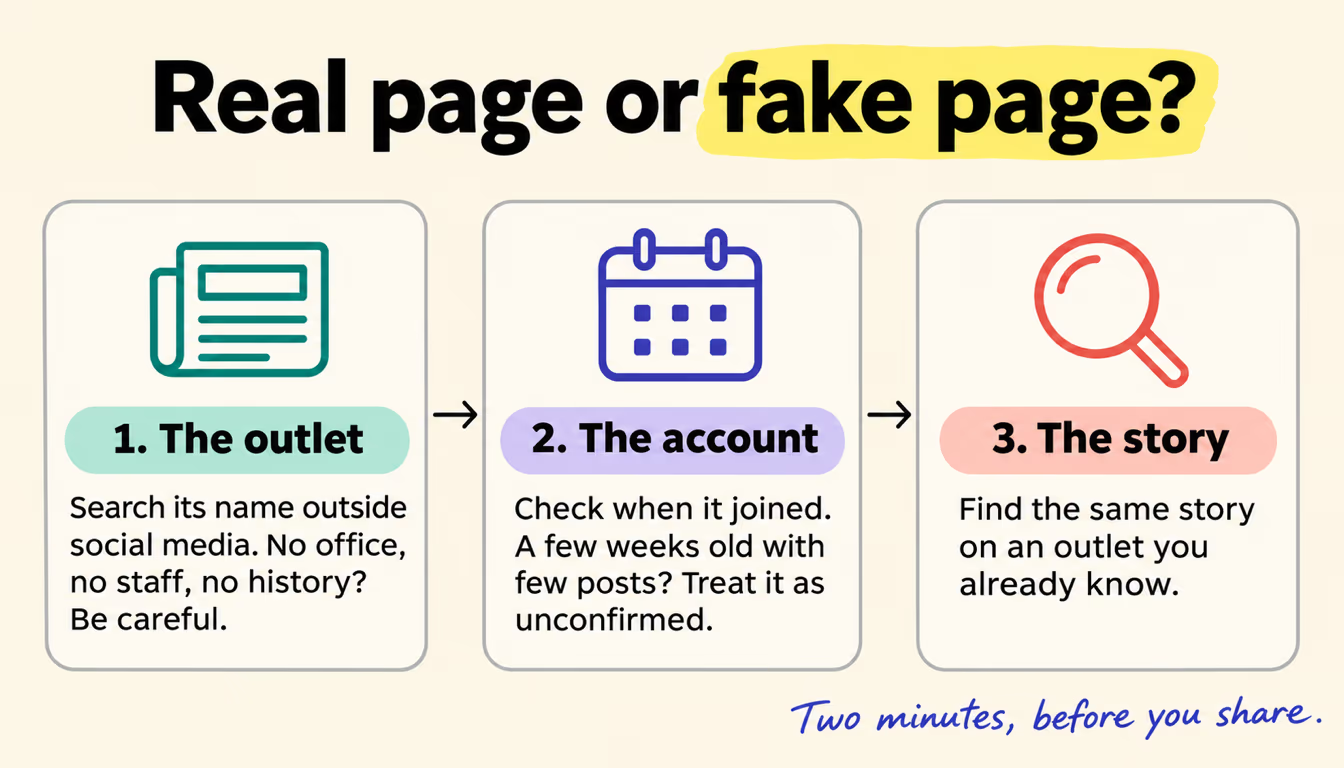 Three checks that take a couple of minutes.
- Check the outlet exists outside social media. A real outlet has an address, named editors and a history you can search. The report says the Malaysia Pulse domain was registered in May 2026.
- Check the account's age. An X profile shows when it joined. A few weeks old, few posts, a strong claim? Treat it as unconfirmed.
- Find the story elsewhere. If no outlet you know carries it, wait before acting or sharing.
For your own brand, be easy to verify. Keep one official website and one official WhatsApp number, and tell customers where you post, so a fake has something real to be checked against.
Worried your business could be faked online? See our cybersecurity services or talk to us for an honest take.
References
- Threat intelligence report, September 2026, Anthropic
- MCMC asks Anthropic to clarify report on Claude-powered voter targeting, Malay Mail, 18 November 2026
- MCMC probes claims Claude AI targeted Malaysian voters but says issue outside its mandate, Bernama via Malay Mail, 12 September 2026
- Istanbul tech firm rejects claims it abused Claude AI to sway M'sian politics, Malaysiakini, 15 September 2026