
A founder asked me last week what "AIO" stood for. I run a company that sells this kind of work, and I still had to stop and think. The agency that pitched her that week meant something different by it than the agency that pitched her the week before. Three definitions in three weeks. That is not her being slow. The market is inventing acronyms faster than anyone can keep up.
So here is what I tell my own clients, even though it is a strange thing to say when I am the one selling the service. Most of this is the same work.
So when you line up GEO vs SEO, is GEO just SEO? Mostly, yes. GEO (generative engine optimization) and SEO share the same inputs: clear writing, real structure, and authority you earned. The difference is narrow. Ranking in Google and getting quoted by an AI engine are no longer the same thing.
Does SEO still matter for AI search?
If your SEO is solid, your presence in AI search is usually solid too. If your SEO is bad, no amount of "GEO optimization" rescues it. There is no separate AI internet. When you ask ChatGPT or Perplexity or Gemini something, they pull from the same web Google crawls. If your site is hard to find, or your pages say nothing, the model that might have cited you has no reason to. That covers most of the picture.
What is the difference between GEO and SEO?
The core difference is intent. SEO optimizes to rank in Google and earn the click. GEO aims to get your page quoted inside an AI-generated answer. The inputs overlap heavily, so the two only separate at the edges, and that part is interesting. A Reddit thread with a couple hundred upvotes can get quoted constantly by Perplexity without ever ranking on Google. A sharp, specific post sitting on page two can show up almost word for word inside a ChatGPT answer. You can rank number one for a query and still never get cited, because ranking and getting quoted stopped being the same thing.
That gap is real. It is also why I would think hard before paying a monthly retainer to "optimize for AI engines." New models ship almost every month, and the way they pick sources shifts with them. Whatever trick worked in spring is half broken by summer. You cannot chase a target moving that fast. You can only build something solid enough that each new model picks it up on its own. Google's own AI Mode and AI Overviews are part of this shift, covered in our Google I/O 2026 guide.
What a 2026 study actually found
A 2026 paper ran the famous GEO checklist through a set of AI engines and measured how often a page got cited. The tactics are the ones every vendor pitches: add statistics, add quotations, cite sources, use an authoritative tone, smooth out the writing.
On GPT-4o-mini, the untouched page got cited 13.34% of the time. After the full checklist of off-the-shelf tactics, it scored between 11.08% and 12.21%. A method called AutoGEO landed at 12.12%. Every one of those generic tricks came in below just leaving the page alone.
But here is the part the "GEO is dead" crowd skips. The researchers also built their own method, called FeatGEO. It scored 18.31%, well above the 13.34% the untouched page got. So the lesson is not that optimization is useless. It is that adding tricks to a weak page does nothing. Making the page genuinely better is what works.
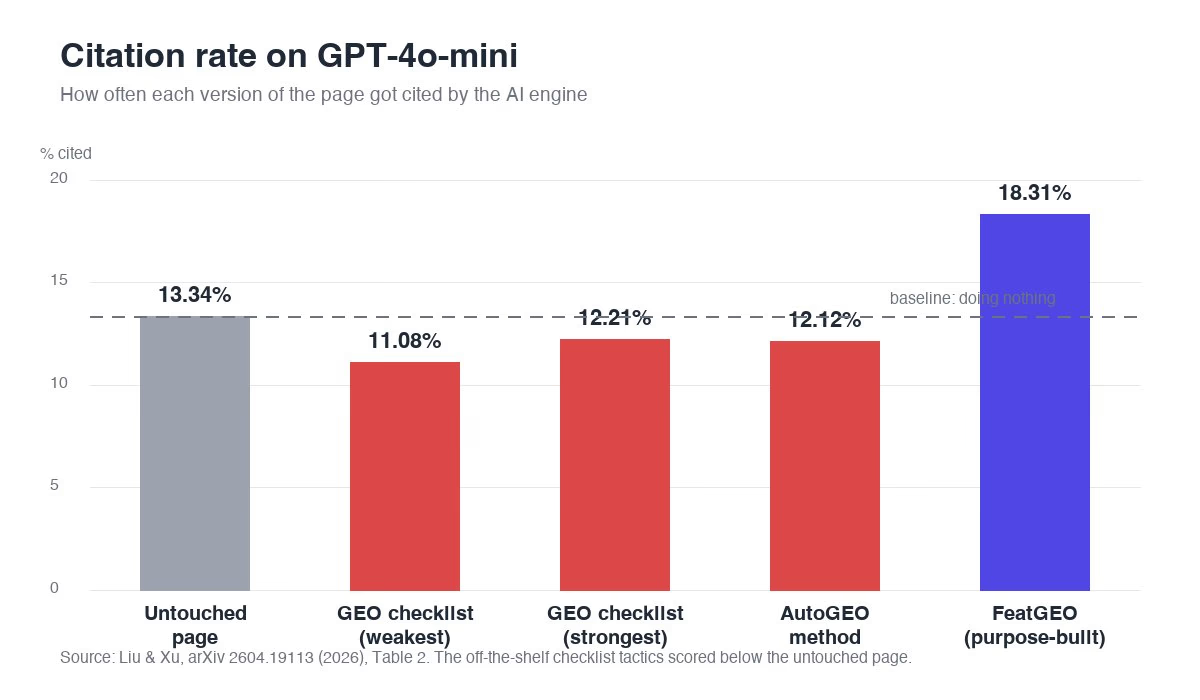 The off-the-shelf checklist tactics (red) all landed below the untouched page. Only the purpose-built method beat the baseline. Source: Liu & Xu, arXiv 2604.19113, Table 2.
Read the caveats before you burn anything. This was tested on stand-in AI engines, not the real ChatGPT or Google AI Overviews, and it is a single early paper others have not checked yet. Other studies disagree: the AutoGEO paper says its method got content cited up to 51% more often. Nobody has settled this. Anyone selling you a fixed checklist as proven science is overclaiming.
But one thing stays standing. What mattered was never the trick. It was whether the page deserved to be quoted at all. The same paper even found that the most-quoted version used a pushy, salesy tone, while a calmer, better-written one got quoted less. Getting quoted and being good are not always the same thing. Build for the reader, not the model.
If I had to compress all of it into two words: substance, not schema.
Most of what gets sold as GEO is formatting. Special schema tags. Question-and-answer layouts. "LLM-friendly" markdown. None of it survives a model update, and all of it comes back to one question. Did you say something worth quoting? Models do not cite you because your heading was structured correctly. They cite you because your sentence was the cleanest version of an idea they could find. A 400-word answer a real person would screenshot beats a 4,000-word guide with perfect schema.
So what should you actually do
None of this is a secret:
- Write the thing a real person would want to read. Make it clear enough that a model can lift one good sentence straight out of it.
- Get your brand mentioned where people already talk. Reddit, niche forums, industry newsletters.
- Stop publishing thin guides that rank for nothing and get cited by nothing.
- Keep the technical basics SEO already taught you. Clean structure, internal links, fast pages, a site that can be crawled.
- Test your own pages. Track which ones AI engines actually cite, and build from what works, not from what a vendor pitched you.
That is the whole strategy. SEO, GEO, AEO, and whatever letter comes next.
What this means if you run a business here
The acronyms exist because someone needed a new thing to sell. Real things did change. AI answers eat into clicks. The way people find you is stranger than it was a year ago. But the answer to a stranger surface is not four disciplines and four invoices. It is to do the boring work well.
And the boring work is hard. That is the part the checklist sellers gloss over. Knowing which page deserves a rewrite, which topic you can actually win, and which "best practice" is about to break in the next model update, that is judgment. It is most of what you are paying anyone for. We would rather give a Malaysian business owner the honest version than sell a monthly "AI optimization" invoice that buys nothing.
One rule for the next few years. Stop building for the algorithm of the month. Build for the person who will quote you.
You are not behind. You were just being sold to.
If you want an honest read on where your site actually stands in AI search, let's chat. No checklist, no sales pitch.
References
- Liu, Z. and Xu, P. "Think Before Writing: Feature-Level Multi-Objective Optimization for Generative Citation Visibility" (April 2026), arXiv. arxiv.org/abs/2604.19113
- Wu, Y., Zhong, S., Kim, Y. and Xiong, C. "What Generative Search Engines Like and How to Optimize Web Content Cooperatively" (2025), arXiv. arxiv.org/abs/2510.11438
- Aggarwal, P. et al. "GEO: Generative Engine Optimization" (2023), arXiv. arxiv.org/abs/2311.09735