The quote is sitting on your desk. It names a price, a timeline, and a long list of what the system will do. What it hides is the AI project scoping behind it, which decides whether this still runs in six months or dies as an expensive demo.
AI project scoping is the work of agreeing what a project must change before anyone agrees a price. A scoped project fills four blanks: which kind of business result it targets, the one number it moves, what that number is today, and where it should be in 60 days. A vendor who cannot fill all four is selling a demo with an invoice attached.
What is AI project scoping, and why does it come before the price?
Scoping is not a feature list. A feature list says what the software will contain. A scope says what will be different in your business afterwards, in a number you already track. Price the build first and the scope bends to fit the price. Scope first and the price has something to be measured against.
The four blanks AI project scoping fills
Ask your vendor to say these four sentences using your figures.
| Blank | Scoped answer | Unscoped answer |
|---|---|---|
| 1. The bucket | "This gets you more customers." (Or: makes each customer worth more, or cuts a named cost.) | "This will make you more efficient." |
| 2. The number | "The metric is quotes sent per week." | "It improves productivity." |
| 3. Today's figure | "You send 40 quotes a week now." | "We will measure once it is live." |
| 4. The target | "In 60 days we expect 65." | "Results depend on adoption." |
If your vendor can say all four without checking their slides, they have looked at your business. If they cannot fill blank three, they never asked what you do today, which makes blank four a wish.
Run this on us too. If Gotchaa Lab quotes you and cannot fill all four, walk.
MDEC's own AI grant pays on KPIs, not on demos
Malaysia's own digital agency applies this standard to its money. MDEC's AI grant, MDAG-AI (applications closed 18 July 2025), sets out how the money moves:
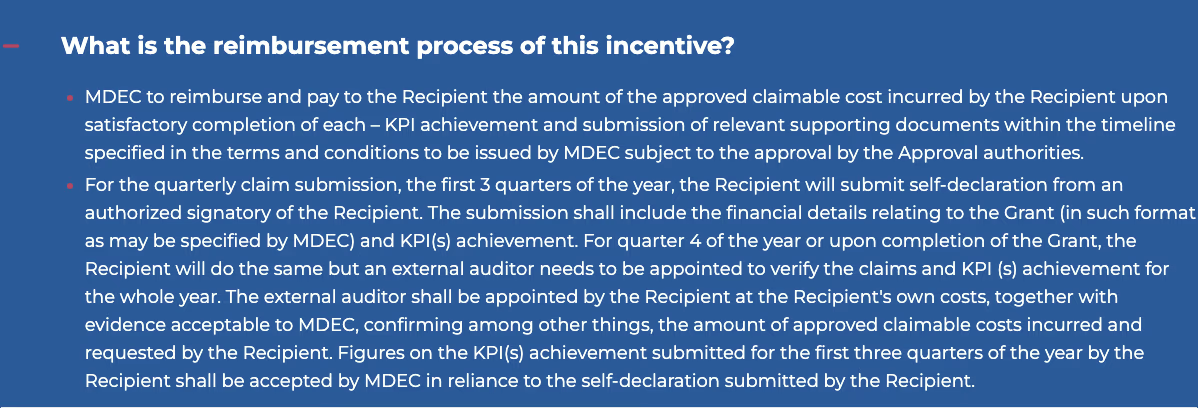 MDEC's MDAG-AI FAQ on reimbursement, captured 17 August 2026.
MDEC to reimburse and pay to the Recipient the amount of the approved claimable cost incurred by the Recipient upon satisfactory completion of each – KPI achievement and submission of relevant supporting documents within the timeline specified in the terms and conditions to be issued by MDEC subject to the approval by the Approval authorities.
Source: MDAG-AI, MDEC
The same page lists what MDEC will not reimburse, and one line is worth reading twice: "Payments to third parties not involved in the contracted project delivery or not clearly linked to KPI outcomes." Your own cash deserves the same rule.
Why most AI projects stop after the demo
Capgemini's 2025 research on agentic AI, a global survey of large organisations, found 2% had deployed AI agents at scale and 12% at partial scale, while 23% were running pilots and 61% were still exploring. Most AI work has not reached daily use, at companies with far bigger budgets than a KL SME.
The pattern behind it is dull. Everyone likes the demo, nobody's Tuesday changes, and the tool quietly stops getting opened. Nothing was measured, so nobody can say when it died.
How to find the one number worth moving
Do not start from the AI. Walk your operation in order: lead comes in, lead gets qualified, order gets confirmed, work gets done, invoice goes out. Listen for where your team sighs.
Then be careful with what you hear. The loudest complaint is usually not the constraint, just the most annoying part of somebody's day. The constraint is the first place where work stops and waits.
And the fix does not have to use AI. More AI means more cost and more surfaces to fail on. If a plain automation moves the same number with fewer moving parts, that is the better build, and a vendor who says so is worth keeping.
Should you pay for a scoping phase?
Usually yes, if the fee is fixed and the document is yours to keep. A paid scope forces the vendor to learn your business before pricing it. A free proposal runs on assumptions nobody made you check, which is how blank three ends up empty. Two things make it fair: a number agreed upfront, and your right to take the scope to a second vendor.
This tests the project, not the company
The four blanks say nothing about whether the vendor can build it. That is a separate check, covered in how to check a software vendor in Malaysia: SSM records, IP ownership, PDPA terms, references you can call. Run both. For price bands see our AI automation agency pricing read, and to write the brief yourself, start with one page on a single job.
Do this today with the quote you already have
Take the quote on your desk. On a blank page, write the four sentences with your own figures in them: the bucket, the metric, today's number, the 60-day target. Every blank you cannot fill is a question for the vendor. Send those questions back. You have not spent a ringgit and you have not hired anyone.
Want a scope you can put through this test? WhatsApp us with the process you want fixed. We come back with the four blanks filled, or an honest answer that we are not the right fit. See our AI solutions work.
General information, not financial advice. Grant details change, so verify with the agency.