YTL AI Labs and NVIDIA have released 1.35 million Malaysians who do not exist. The dataset is called Nemotron-Personas-Malaysia, and it was announced on 23 September 2026. For a Malaysian business about to launch a customer-service bot, it's a cheap way to test your AI chatbot on people who don't talk like your own team.
What YTL AI Labs and NVIDIA actually released
A synthetic persona is a made-up person whose details follow real population statistics. Nobody in the set exists, but the mix of ages, jobs and places matches the country. Here's what The Star, Lowyat.NET and EdgeProp report:
| What | Detail |
|---|---|
| Size | 1.35 million personas, grown from 150,000 base records |
| Fields | 39 per persona, including age, gender, job, location and personality, down to district level |
| Language | Bahasa Melayu first, a first for NVIDIA's persona collection |
| Coverage | Malay, Chinese, Indian, Kadazan-Dusun, Bajau, Murut, Iban, Bidayuh, Melanau and more |
| Built from | Department of Statistics Malaysia, OpenDOSM, MyCensus, eStatistik |
| Licence | CC-BY-4.0, free for commercial use |
YTL AI Labs CEO Foong Chee Mun said AI should be judged not only by model size, "but also by its ability to understand the communities it serves" (Sabah Media, translated from Malay). The same team makes ILMU.
The catch: reports say the dataset is on Hugging Face, but when we checked on 24 September, NVIDIA's public collection listed ten countries and Malaysia wasn't among them.
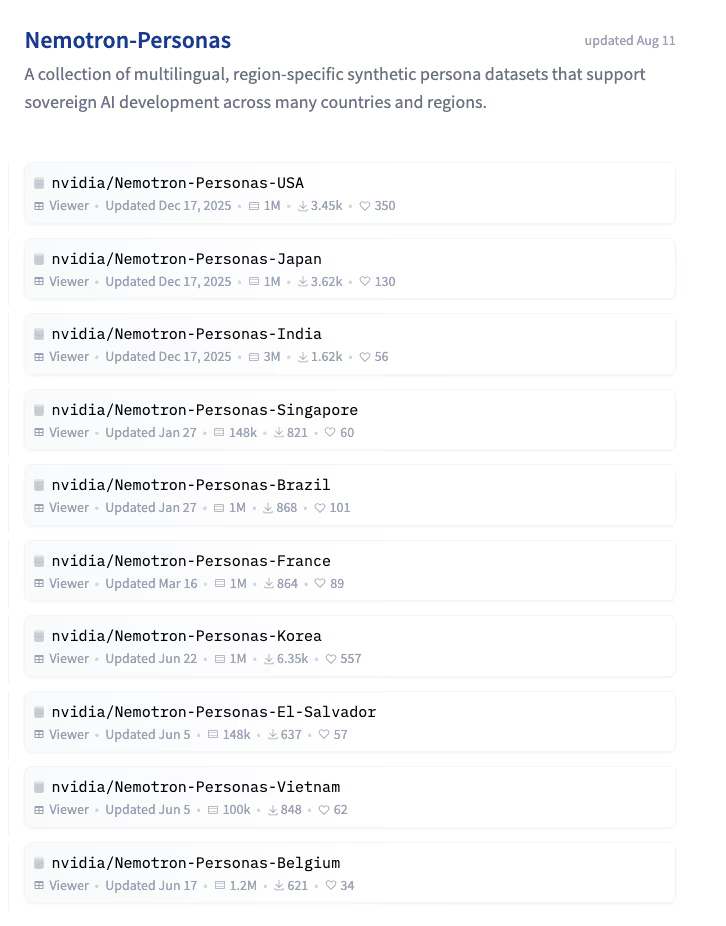 NVIDIA's Nemotron-Personas collection, captured 24 September 2026 at 11:30am, with thumbnails removed so the list fits. Source: Hugging Face
Until it shows up, don't plan a launch around a link you haven't seen. And don't confuse it with Malaysia-Personas, an unrelated community dataset posted the same day.
How do you test an AI chatbot with fake Malaysians?
To test an AI chatbot, write down what a correct reply looks like, send the bot messages from many different kinds of customers, and check every answer against your list. Personas make the second step cheap. Most bots are only tested by the people who built them, and they already know what the bot should say.
- Write down what a correct reply looks like. Five to ten checks: answers in the customer's language, quotes the right price, never invents a policy, hands over to a human when stuck.
- Pick 50 personas across states, ages and jobs, say a retired teacher in Kuching or a Grab driver in Klang.
- Have an AI write each persona's first message in their voice, whether that's formal BM, Manglish, or two angry words.
- Send those messages to your bot, score every reply against your checks, and read the failures yourself.
Our PMX AI outage post shows what skipping this can cost.
What testing an AI chatbot on fake customers misses
We'd use this dataset to catch obvious gaps, like a bot that answers a Tawau customer's Sabah Malay in English. Personas come from averages. Real customers send voice notes, blurry screenshots and three messages in a row, and they ask about last week's promo. No dataset knows about that.
The persona descriptions are written by a language model too, so they may sound tidier than real people. Read a passing score as "no obvious gaps", not "ready".
One plus: with made-up people, you don't paste real customer chats into a test tool. Here's where customer data goes in AI tools.
How this affects Malaysian businesses
If someone is building a chatbot for you, ask who tested it and how those testers wrote. If the answer is "our team", this dataset gives you a free way to ask for more.
Then soft launch to a small group of real customers, with a human watching every chat. That's where the real problems show up.
At Gotchaa Lab we build and test AI chatbots and agents for Malaysian businesses. Talk to us if you want a second opinion before yours goes live.
References
- YTL AI Labs, NVIDIA launch open dataset reflecting Malaysia's population diversity, The Star
- YTL AI Labs Teams Up With NVIDIA To Build Dataset For Malaysia-Focused AI, Lowyat.NET
- YTL AI Labs Lancar Set Data NVIDIA Nemotron-Personas-Malaysia, Sabah Media
- YTL AI Labs, Nvidia release 1.35 million synthetic Malaysian personas, EdgeProp.my
- Nemotron-Personas collection, NVIDIA on Hugging Face